
|
🚧 Marketingadss is currently being redesigned to better serve you. Online services and purchases will be available soon.
|
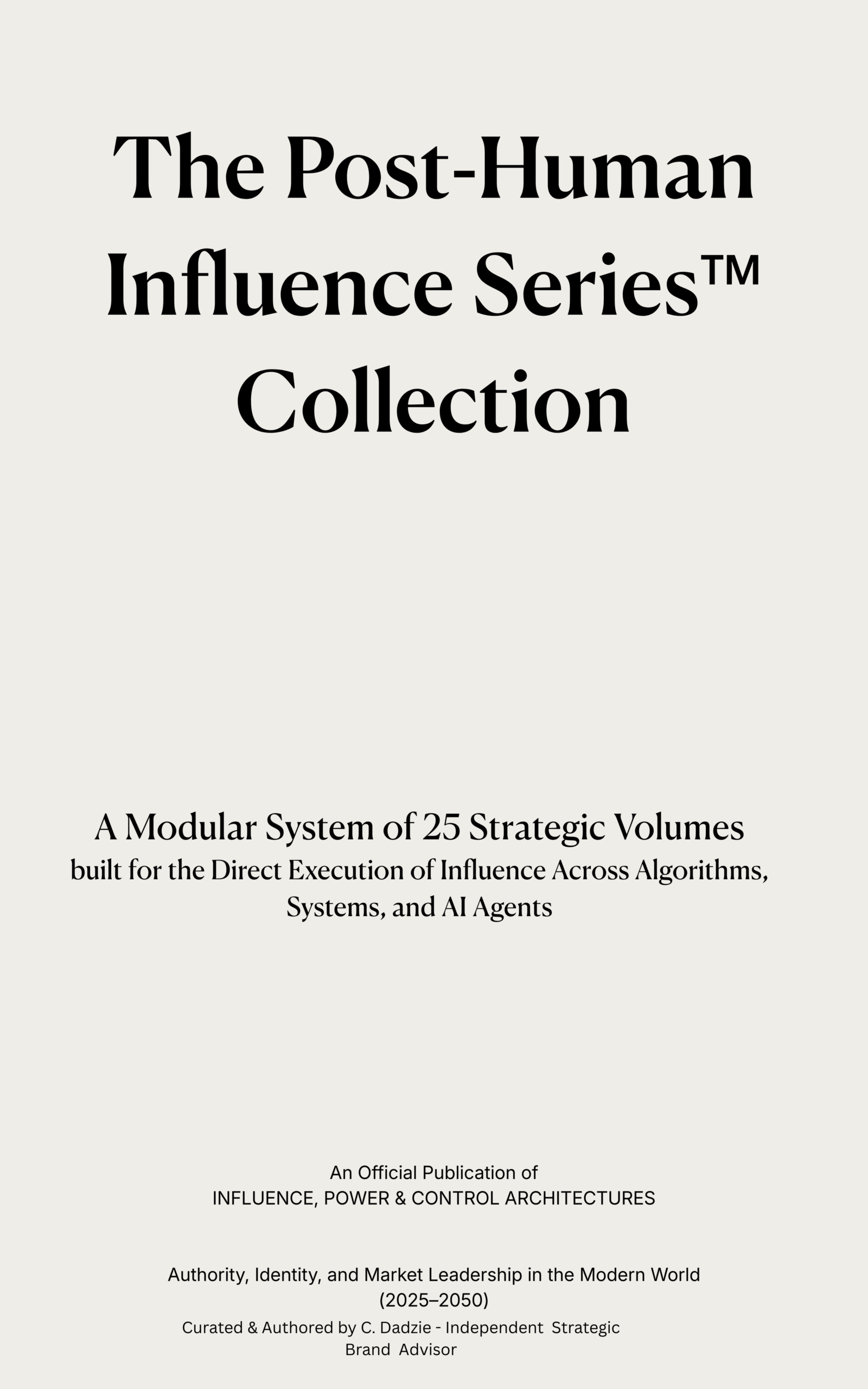
€ 6500
Influence is no longer human-led.
It is system-led.
This collection reveals how power is shifting from individuals to infrastructures — and why those who continue to “communicate” will lose to those who architect influence environments.
Without this collection, you optimize messages.
With it, you design non-human influence systems.
What you lose without this collection:
You fight for attention in a world that has already moved on.
This collection operates within the Foundational Axiom established by the Institute.
Influence no longer targets humans.
It targets the systems that decide for them.
A structured methodology to align leadership,
redesign decision architecture and accelerate execution.
Siemens successfully evolved from a traditional
engineering company into a leader in industrial automation.
This transformation required:
• strategic portfolio redesign
• digital infrastructure investments
• organizational restructuring
Large organizations must periodically redesign
their strategic architecture to remain competitive.
1. Strategic Deconstruction
Identifying structural barriers to execution.
2. Decision Architecture
Redesigning how strategic decisions are made.
3. Organizational Alignment
Aligning leadership structures and incentives.
4. Strategic Adaptability
Building systems capable of responding to change.
• leadership misalignment
• slow decision cycles
• organizational complexity
• strategy disconnected from execution
It fails because organizations cannot execute them.
This system is built on years of research into
organizational strategy, leadership alignment and
decision architecture inside complex organizations.
Phase 1 — Strategic Diagnostic
Analyzing organizational execution barriers.
Phase 2 — Leadership Alignment
Aligning leadership teams around strategic priorities.
Phase 3 — Decision Architecture
Redesigning how strategic decisions are made.
Phase 4 — Execution Acceleration
Implementing new strategic operating principles.
⭐⭐⭐⭐⭐
Challenge
Our team understood traditional influence and marketing strategies, but we lacked a clear framework to understand how AI and digital systems are reshaping influence in modern markets.
What we implemented
After studying the post-human influence frameworks in this collection, we redesigned how we approach communication strategies in a world where human and machine intelligence interact.
Result
The frameworks helped us anticipate how influence systems are evolving and allowed us to adapt our communication strategy to a much more technologically driven environment.
Dr. Elena S. — Technology & Society Researcher — Stockholm
Frameworks applied
• Post-Human Influence Model
• Human-Machine Communication Framework
• Digital Influence Architecture
Application context
• Technology research institute
• Strategic foresight team
• European market
⭐⭐⭐⭐⭐
Challenge
Our company was investing heavily in AI tools, but we lacked a strategic understanding of how these technologies change influence, media and communication.
What we implemented
The strategic frameworks in this collection helped us rethink how AI-driven communication systems will shape future brand influence.
Result
The new perspective allowed us to design communication strategies that align with emerging technological trends rather than relying on outdated models.
Daniel C. — Innovation Strategy Manager — Toronto
Frameworks applied
• AI Influence Framework
• Future Communication Systems
• Machine-Driven Media Model
Application context
• Innovation department
• Technology company
• North American market
⭐⭐⭐⭐⭐
Challenge
Our media strategy was built around traditional audience engagement models that were becoming less effective in an AI-driven information environment.
What we implemented
Using the frameworks from this collection, we redesigned how we analyze digital influence networks and algorithmic media environments.
Result
This helped our team better understand how information flows in modern digital ecosystems and how influence operates at scale.
Laura M. — Media Strategy Consultant — London
Frameworks applied
• Algorithmic Influence Framework
• Digital Network Analysis Model
• Future Media Architecture
Application context
• Media strategy consulting
• Global clients
• European market
Access to this system is intentionally limited to a small number of organizations each year.
Strategic Investment: $6,500
• One-time payment
• Lifetime system license
• Immediate access upon purchase
• Full framework and methodology access
• All future updates included
• Designed for executives and organizations
Level: Strategic Advisory
Format: Digital Access
🔒Secure payment processing. All transactions are encrypted and protected.
Instant access is provided immediately after purchase.
THE POST-HUMAN INFLUENCE SERIES™
is not a marketing course.
It is a strategic framework for understanding how influence operates in an algorithm-driven world.
Price: $6,500
Theme: Influence • Power • Authority Systems in the Post-Human Era
We are entering a new phase of economic power.
In the past, influence belonged to those who controlled:
• media exposure
• advertising reach
• celebrity endorsement
• mass communication channels
Today, influence operates differently.
Power is increasingly exercised through:
• algorithmic recommendation systems
• behavioral data architectures
• digital ecosystems
• platform visibility mechanisms
Influence is no longer simply persuasive.
It is structural.
Organizations that understand how influence systems work can shape consumer behavior, market perception, and purchasing pathways at scale.
Those that do not are gradually losing control of their market position.
The Post-Human Influence Series™ is designed to help leaders understand this transformation.
Many organizations are still operating with influence models designed for a previous era.
They rely on:
• advertising campaigns
• fragmented marketing initiatives
• short-term visibility tactics
• reactive customer acquisition strategies
These approaches generate temporary attention but rarely create durable influence.
Meanwhile, the most powerful companies are building something different.
They are designing influence architectures.
Instead of pushing messages, they shape the environments where decisions are made.
Influence becomes embedded in systems.
Traditional influence relied on persuasion.
Post-human influence relies on systems.
In the digital economy, influence emerges when multiple structural forces operate together:
• algorithmic visibility
• behavioral design
• ecosystem participation
• narrative authority
• data intelligence
When these elements combine, influence compounds over time.
It becomes increasingly difficult for competitors to replicate.
Most organizations operate with fragmented influence mechanisms.
Diagnosis identifies:
• weak digital ecosystems
• disconnected consumer data
• reactive marketing structures
• misaligned authority signals
The goal is to reveal where influence is currently leaking.
Algorithms increasingly determine:
• what people see
• what products they discover
• what brands they trust
• what decisions they make
Understanding algorithmic authority means understanding the new gatekeepers of influence.
Influence today often works invisibly.
Instead of persuasion, organizations design:
• decision environments
• choice architectures
• psychological reinforcement loops
These structures guide behavior naturally.
The strongest brands no longer sell individual products.
They build ecosystems where:
• customers return repeatedly
• behavioral data accumulates
• network effects strengthen authority
Influence compounds as participation grows.
Even in algorithmic systems, narrative remains essential.
Organizations must control:
• identity
• positioning
• perception
• strategic storytelling
Narrative reinforces the authority structure of the ecosystem.
Below are examples of how post-human influence operates in modern retail ecosystems.
Current Situation
Large retailers increasingly influence consumer behavior through:
• recommendation engines
• dynamic pricing systems
• digital platforms
• loyalty ecosystems
Influence no longer occurs only through advertising.
It occurs inside data-driven decision environments.
Strategic Opportunity
Design a Post-Human Influence System™
Instead of pushing promotions, the company shapes purchasing behavior through:
predictive purchasing signals
recommendation ecosystems
loyalty reinforcement loops
algorithmic pricing influence
Impact
Retailers no longer react to demand.
They architect demand.
Observation
Retail influence is shifting away from physical locations toward:
• data ecosystems
• mobile applications
• personalized digital offers
Consumer interaction increasingly happens inside digital environments.
Post-Human Strategy
Retailers can create consumer influence architectures based on:
• behavioral prediction
• personalized digital experiences
• ecosystem loyalty loops
The brand becomes a behavior-shaping system.
Diagnostic
Costco has built influence through:
• curated product selection
• price credibility
• membership loyalty
Strategic Insight
Trust systems can evolve into algorithmic authority systems when combined with digital infrastructure.
Influence compounds when:
• credibility
• ecosystem loyalty
• behavioral data
operate together.
Many organizations rely on:
• traditional marketing
• isolated campaigns
• fragmented customer insight
• short-term acquisition tactics
Influence remains temporary and inconsistent.
Organizations design:
• integrated data ecosystems
• behavioral influence systems
• algorithmic authority structures
Influence becomes self-reinforcing.
Customer behavior begins to compound.
Market authority strengthens over time.
Influence is not abstract.
It directly affects revenue.
When organizations improve:
• customer retention
• purchase frequency
• perceived authority
• ecosystem participation
financial performance increases.
Retail company revenue: $10M
If behavioral influence increases purchasing frequency by 10%, revenue increases by $1M.
Investment in strategic architecture: $6,500
The leverage becomes obvious.
Small improvements in influence systems can generate disproportionately large economic outcomes.
A strategic framework designed for leaders navigating the algorithmic economy.
This is not a marketing course.
It is a high-level strategic model for understanding how influence operates in a world shaped by algorithms, data ecosystems, and behavioral architectures.
You will learn how to:
• diagnose influence systems inside modern organizations
• understand algorithmic authority structures
• design behavioral influence environments
• build ecosystem-based power
• control strategic narratives in digital markets
$6,500
Executive-level strategic framework.
Designed for:
• founders
• executives
• strategy leaders
• consultants
• investors
• influence architects
🔒Secure payment processing. All transactions are encrypted and protected.
Instant access is provided immediately after purchase.
Lorem ipsum dolor sit amet, consectetur adipiscing elit. Ut elit tellus, luctus nec ullamcorper mattis, pulvinar dapibus leo.
This framework is not priced as a course.
It is priced as strategic leverage.
Most organizations dramatically underestimate the economic impact of influence architecture.
Yet influence determines:
• what customers see
• what they trust
• what they buy
• and how often they return.
When influence systems change, revenue changes.
Consider a simple scenario.
A company generating €10M in annual revenue improves just three metrics:
• customer retention
• purchasing frequency
• perceived brand authority
Even a 5–10% behavioral shift can produce €500K–€1M in additional revenue.
This is the economic reality of influence architecture.
The question is therefore not:
“Is €6,500 expensive?”
The real question is:
What is the value of understanding the system that shapes demand itself?
Most marketing education focuses on tactics:
• advertising campaigns
• social media growth
• content production
• funnel optimization
These skills are widely available.
They create incremental improvements.
The Post-Human Influence Series™ operates at a different level.
It focuses on structural influence systems.
The frameworks inside this series explain how organizations can design:
• algorithmic authority
• behavioral decision environments
• ecosystem power structures
• strategic narrative control
These are the mechanisms behind the world’s most powerful companies.
Many organizations still operate with outdated influence models.
They rely on:
• fragmented marketing
• short-term acquisition tactics
• isolated campaigns
• reactive strategy
As algorithmic environments become dominant, these approaches become less effective every year.
The cost of misunderstanding influence is not €6,500.
The cost is years of strategic misalignment.
Executives regularly pay:
• €3,000–€10,000 for industry conferences
• €5,000–€20,000 for executive education programs
• €10,000–€50,000+ for strategic consulting engagements
Yet most of these experiences deliver information, not frameworks.
The Post-Human Influence Series™ delivers a model for understanding influence in the algorithmic age.
This framework is intentionally not priced for mass consumption.
It is designed for individuals who:
• operate in positions of strategic responsibility
• understand the value of leverage
• think in terms of systems, not tactics
When knowledge affects decisions that influence millions in revenue, pricing must reflect its strategic value.
This investment provides access to the complete Post-Human Influence Architecture™.
A strategic framework designed to help leaders understand how influence operates in a world shaped by:
• algorithms
• data ecosystems
• behavioral design
• authority systems
If understanding influence systems improves even one strategic decision, the return on investment can be exponential.
Because in the algorithmic economy:
those who understand influence systems shape markets.
Those who do not are shaped by them.
🔒Secure payment processing. All transactions are encrypted and protected.
Instant access is provided immediately after purchase.
We use cookies and similar technologies to ensure the proper functioning of this website, to analyze traffic, and to improve your experience.
You can accept all cookies, reject non-essential cookies, or customize your preferences at any time.