
|
🚧 Marketingadss is currently being redesigned to better serve you. Online services and purchases will be available soon.
|
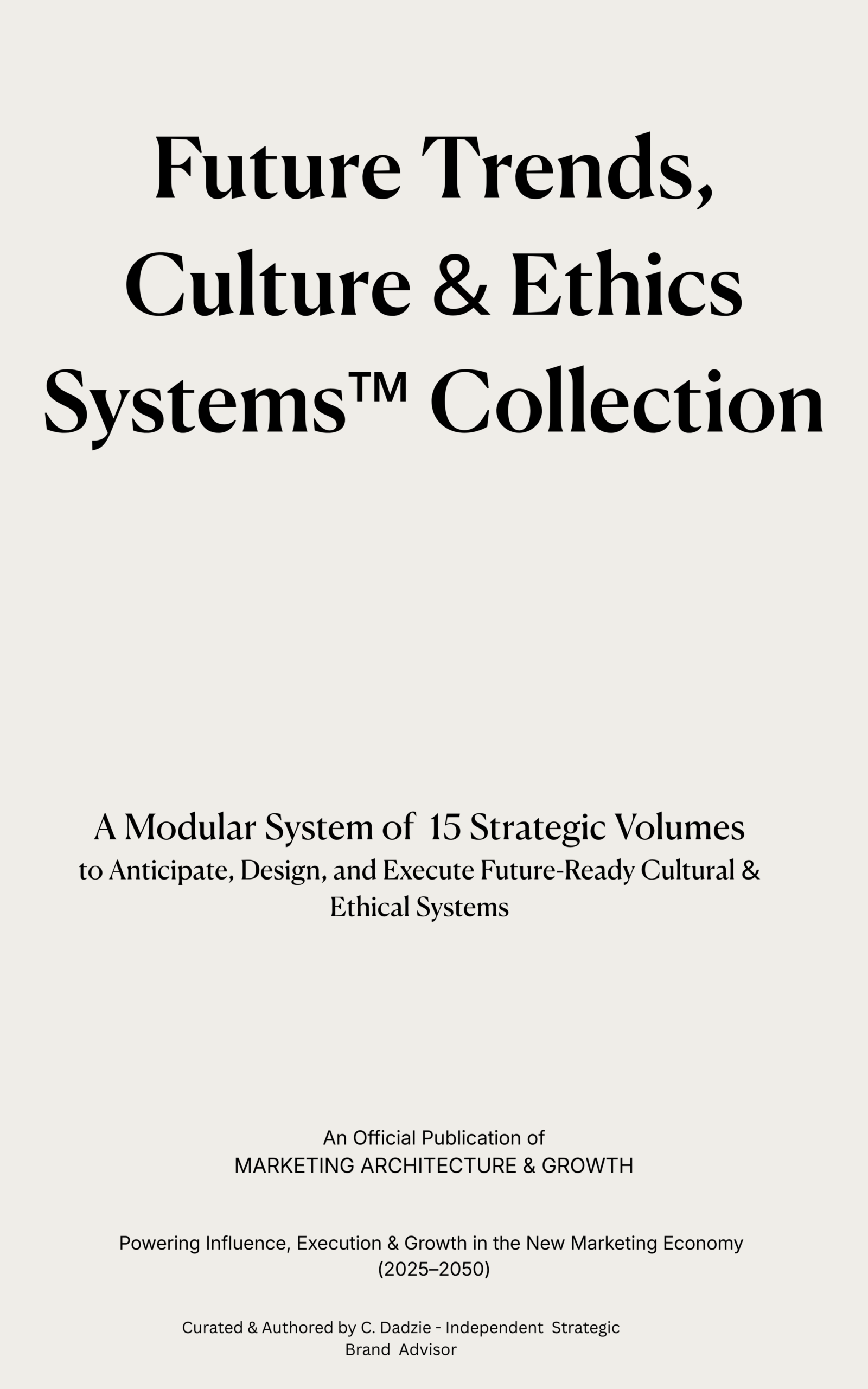
€ 3200
Trends do not change markets.
Culture does.
This collection teaches you how to anticipate shifts before they become visible, and how ethics quietly determine who survives when systems evolve.
Without it, you react to change.
With it, you position yourself ahead of it.
What you lose without this collection:
You adapt too late — and pay the price of delay.
A structured methodology to align leadership,
redesign decision architecture and accelerate execution.
Siemens successfully evolved from a traditional
engineering company into a leader in industrial automation.
This transformation required:
• strategic portfolio redesign
• digital infrastructure investments
• organizational restructuring
Large organizations must periodically redesign
their strategic architecture to remain competitive.
1. Strategic Deconstruction
Identifying structural barriers to execution.
2. Decision Architecture
Redesigning how strategic decisions are made.
3. Organizational Alignment
Aligning leadership structures and incentives.
4. Strategic Adaptability
Building systems capable of responding to change.
• leadership misalignment
• slow decision cycles
• organizational complexity
• strategy disconnected from execution
It fails because organizations cannot execute them.
This system is built on years of research into
organizational strategy, leadership alignment and
decision architecture inside complex organizations.
Phase 1 — Strategic Diagnostic
Analyzing organizational execution barriers.
Phase 2 — Leadership Alignment
Aligning leadership teams around strategic priorities.
Phase 3 — Decision Architecture
Redesigning how strategic decisions are made.
Phase 4 — Execution Acceleration
Implementing new strategic operating principles.
⭐⭐⭐⭐⭐
Challenge
Our brand strategy team was focused on short-term marketing performance, but we lacked a deeper understanding of how cultural shifts and social dynamics influence long-term brand perception.
What we implemented
After studying the cultural strategy frameworks from this collection, we integrated cultural trend analysis into our long-term marketing planning.
Result
The change helped us anticipate shifts in consumer expectations and design campaigns that resonate with broader social narratives rather than just short-term attention.
Clara B. — Cultural Strategy Analyst — Copenhagen
Frameworks applied
• Cultural Influence Framework
• Social Trend Mapping System
• Future Narrative Architecture
Application context
• Brand strategy team
• Global campaigns
• European market
⭐⭐⭐⭐⭐
Challenge
Our organization wanted to address ethical considerations in marketing, but we lacked a structured framework to guide decision-making.
What we implemented
The ethical influence models in this collection helped us establish clear internal guidelines for responsible communication and brand positioning.
Result
These frameworks allowed our leadership team to align marketing strategies with long-term brand trust and credibility.
Dr. Hannah E. — Ethics & Technology Researcher — Oxford
Frameworks applied
• Ethical Influence Framework
• Responsible Communication Model
• Trust Architecture System
Application context
• Corporate communications team
• Global brand
• European market
⭐⭐⭐⭐⭐
Challenge
Our strategy team needed a better understanding of how technological change and cultural evolution interact in shaping future markets.
What we implemented
The future trend frameworks in this collection helped us build a strategic foresight model to analyze emerging social and economic patterns.
Result
This new perspective allowed us to anticipate changes in consumer behavior and adapt our long-term strategy accordingly.
Daniel C. — Strategic Foresight Consultant — Toronto
Frameworks applied
• Future Trend Analysis Model
• Cultural Evolution Framework
• Strategic Foresight System
Application context
• Strategy consulting firm
• Corporate clients
• North American market
Access to this system is intentionally limited to a small number of organizations each year.
Strategic Investment: $3,200
• One-time payment
• Lifetime system license
• Immediate access upon purchase
• Full framework and methodology access
• All future updates included
• Designed for executives and organizations
Level: Strategic Advisory
Format: Digital Access
🔒Secure payment processing. All transactions are encrypted and protected.
Instant access is provided immediately after purchase.
Theme: Marketing • Cultural Strategy • Future Trends
Executive Program Price: $3,200
The companies that dominate the future are not simply better at marketing.
They are better at understanding the future itself.
FUTURE TRENDS, CULTURE & ETHICS SYSTEMS™ is designed for leaders, consultants, and strategic thinkers who want to understand the deeper forces shaping markets, culture, and ethical leadership in the decades ahead.
This program positions you not as a marketer…
…but as a strategic architect of future markets.
Markets are not only shaped by products.
They are shaped by technology, culture, and ethical expectations.
The most influential organizations in the world understand that long-term market leadership depends on their ability to anticipate transformation.
The companies that shape the next generation of markets study three strategic forces:
• Emerging technological systems
• Cultural and societal evolution
• Long-term ethical responsibility
Organizations capable of understanding these forces do not merely react to markets.
They design the future of industries.
FUTURE TRENDS, CULTURE & ETHICS SYSTEMS™ explores the strategic frameworks behind this transformation.
Most companies operate with a short-term strategic horizon.
Their decision-making revolves around:
• quarterly financial results
• short-term marketing campaigns
• immediate performance indicators
While these metrics matter, they rarely produce long-term market leadership.
The real risk is deeper.
Organizations that ignore cultural evolution and ethical expectations eventually lose relevance.
Markets constantly evolve through:
• technological disruption
• generational change
• shifting social values
Companies that fail to anticipate these forces often find themselves reacting to change rather than shaping it.
Strategic foresight is therefore becoming one of the most valuable capabilities in modern business.
The transformation of markets follows a structural relationship between three forces:
Technology × Culture × Ethics
When these forces converge, entirely new industries emerge.
Technological breakthroughs create new capabilities.
Cultural transformation changes what people desire.
Ethical expectations reshape what societies accept.
Companies capable of aligning these three forces are far more likely to dominate emerging markets.
This framework allows leaders to analyze industries not only in terms of products…
…but in terms of historical evolution and future trajectories.
Three examples illustrate how visionary companies design the future.
Situation
SpaceX fundamentally transformed the aerospace industry through:
• reusable rocket technology
• aggressive innovation cycles
• a powerful long-term mission
Strategic Insight
SpaceX does not simply build rockets.
It builds a narrative about the future of humanity in space.
This narrative mobilizes:
• global talent
• long-term investors
• worldwide public attention
Strategic Lesson
Companies that lead future markets often define ambitious visions of progress that reshape entire industries.
Blue Origin operates with a long-term mission:
“Millions of people living and working in space.”
Unlike many companies focused on short-term returns, Blue Origin embraces a multi-generational horizon.
Strategic Lesson
Future market leaders often invest in technologies that may take decades to fully mature.
This perspective allows them to shape industries long before competitors understand their significance.
Airbus represents a different but equally powerful strategic model.
The company focuses on developing:
• sustainable aviation technologies
• advanced aerospace engineering
• global transportation infrastructure
Strategic Lesson
The next generation of markets will increasingly value innovation combined with responsibility.
Technological leadership alone will not be sufficient.
Ethical and environmental responsibility will become core competitive advantages.
Organizations operating without strategic foresight often experience:
• reactive decision-making
• declining cultural relevance
• difficulty adapting to technological disruption
Their strategies are built around present conditions rather than future dynamics.
Organizations that adopt future-oriented frameworks gain:
• strategic foresight
• cultural intelligence
• long-term competitive advantage
Instead of reacting to change…
they become architects of emerging markets.
Strategic foresight dramatically increases the probability of capturing emerging industries.
History repeatedly demonstrates that companies capable of anticipating major shifts often dominate entire markets.
Examples across industries show the same pattern:
Organizations that invest early in future technologies, cultural transformation, and ethical leadership frequently outperform competitors over long time horizons.
The reason is simple.
They are not competing within existing markets.
They are creating the next ones.
FUTURE TRENDS, CULTURE & ETHICS SYSTEMS™
is a high-level strategic framework designed for:
• consultants
• executives
• strategists
• founders
• future-oriented marketers
This program provides a structured methodology for understanding:
• technological disruption
• cultural transformation
• ethical leadership systems
• future market architecture
Rather than focusing on tactical marketing techniques, the program teaches how markets themselves evolve.
• The Future Market Formula™
• The 5 Pillars of Future Strategy™
• Strategic trend analysis methods
• Cultural intelligence frameworks
• Ethical leadership positioning
• Future-oriented narrative construction
Trend Anticipation
Understanding technological breakthroughs, demographic shifts, and economic transformation.
Cultural Intelligence
Decoding generational expectations, social narratives, and evolving values.
Ethical Leadership
Building trust through transparency, responsibility, and sustainable vision.
Innovation Strategy
Investing in research, emerging technologies, and disruptive ideas.
Strategic Narrative
Creating a compelling story about the future that inspires markets.
FUTURE TRENDS, CULTURE & ETHICS SYSTEMS™
Executive Strategic Program
Investment: $3,200
Designed for professionals who want to move beyond tactical marketing and develop the ability to analyze the future architecture of markets.
FUTURE TRENDS, CULTURE & ETHICS SYSTEMS™
is not a program about marketing tactics.
It is a strategic framework for understanding the forces that will shape the future of markets, culture, and global economic systems.
🔒Secure payment processing. All transactions are encrypted and protected.
Instant access is provided immediately after purchase.
Lorem ipsum dolor sit amet, consectetur adipiscing elit. Ut elit tellus, luctus nec ullamcorper mattis, pulvinar dapibus leo.
Serious strategic thinking has always been valuable.
Not because of the time it takes to produce ideas —
but because of the decisions those ideas influence.
Most strategic decisions in business influence:
• multi-year market positioning
• brand perception
• long-term revenue growth
• competitive advantage
A single strategic insight can shape decisions worth millions over time.
The purpose of FUTURE TRENDS, CULTURE & ETHICS SYSTEMS™ is precisely to develop the type of thinking that helps leaders anticipate those decisions earlier than competitors.
Many organizations underestimate the cost of not seeing the future early enough.
History is full of companies that lost leadership because they failed to anticipate:
• technological disruption
• cultural change
• new ethical expectations
Strategic blindness rarely destroys companies overnight.
Instead, it slowly erodes relevance.
Markets evolve.
Culture evolves.
Consumer expectations evolve.
And companies that fail to understand these transformations often spend far more trying to catch up later.
Most marketing education focuses on:
• advertising tactics
• campaign execution
• platform optimization
These skills are useful.
But they rarely determine who leads markets.
Market leadership is usually determined by something deeper:
the ability to understand where the world is going.
This program focuses precisely on that capability.
Strategic insight at the highest level is rarely inexpensive.
Typical strategic advisory pricing includes:
• Senior consultants: €1,500 – €3,500 per hour
• Strategic advisory retainers:
€20,000 – €150,000 per year
• Executive strategy programs:
€8,000 – €60,000
In that context, FUTURE TRENDS, CULTURE & ETHICS SYSTEMS™ is designed to make high-level strategic thinking accessible without requiring consulting retainers or executive program fees.
The program is positioned intentionally at a level that reflects:
• the intellectual depth of the frameworks
• the strategic nature of the content
• the long-term value of future-oriented thinking
At the same time, it remains significantly below the cost of traditional strategic advisory services.
The objective is simple:
Provide executive-level strategic frameworks without the cost structure of consulting firms.
This is not a program designed to teach marketing tactics.
It is designed to develop a strategic lens on the evolution of markets and society.
Participants use these frameworks to better understand:
• technological disruption
• cultural transformation
• ethical leadership expectations
• emerging economic systems
Over time, these insights influence how organizations position themselves in the future economy.
The question is not:
“Is €3,200 expensive?”
The real question is:
What is the value of understanding the future earlier than competitors?
Because in every industry, the organizations that see the future first often become the ones that define it.
FUTURE TRENDS, CULTURE & ETHICS SYSTEMS™
Strategic Executive Program
Investment: €3,200
For professionals who want to move beyond tactical thinking and develop the ability to analyze the forces shaping the future of markets.
🔒Secure payment processing. All transactions are encrypted and protected.
Instant access is provided immediately after purchase.
We use cookies and similar technologies to ensure the proper functioning of this website, to analyze traffic, and to improve your experience.
You can accept all cookies, reject non-essential cookies, or customize your preferences at any time.