|
🚧 Marketingadss is currently being redesigned to better serve you. Online services and purchases will be available soon.
|
€ 2900
People do not decide rationally.
They rationalize decisions already made by structure.
This collection gives you practical control over how choices are formed before awareness, using applied behavioral science, cognitive bias systems, and decision architecture.
Without this collection, you influence behavior accidentally.
With it, you design decisions deliberately.
What you lose without it:
You keep asking why people don’t choose you — instead of deciding when they will.
A structured methodology to align leadership,
redesign decision architecture and accelerate execution.
Siemens successfully evolved from a traditional
engineering company into a leader in industrial automation.
This transformation required:
• strategic portfolio redesign
• digital infrastructure investments
• organizational restructuring
Large organizations must periodically redesign
their strategic architecture to remain competitive.
1. Strategic Deconstruction
Identifying structural barriers to execution.
2. Decision Architecture
Redesigning how strategic decisions are made.
3. Organizational Alignment
Aligning leadership structures and incentives.
4. Strategic Adaptability
Building systems capable of responding to change.
• leadership misalignment
• slow decision cycles
• organizational complexity
• strategy disconnected from execution
Strategy rarely fails because of ideas.
It fails because organizations cannot execute them.
This program is built on years of research into
organizational strategy, leadership alignment and
decision architecture inside complex organizations.
Phase 1 — Strategic Diagnostic
Analyzing organizational execution barriers.
Phase 2 — Leadership Alignment
Aligning leadership teams around strategic priorities.
Phase 3 — Decision Architecture
Redesigning how strategic decisions are made.
Phase 4 — Execution Acceleration
Implementing new strategic operating principles.
⭐⭐⭐⭐⭐
Challenge
Our marketing campaigns were generating traffic but conversions were inconsistent. We realized we understood the market but not the psychology behind customer decisions.
What we implemented
We applied several behavioral frameworks from this collection to redesign our customer journey and messaging structure.
Result
The changes helped us align our messaging with how people actually make decisions. As a result our landing pages and campaigns started performing significantly better.
Dr. Andrew P. — Consumer Behavior Researcher — Boston
Frameworks applied
• Behavioral Decision Framework
• Cognitive Bias Mapping
• Persuasion Architecture Model
Application context
• Digital marketing team
• E-commerce company
• North American market
⭐⭐⭐⭐⭐
Challenge
Our sales team was struggling to understand why certain prospects were interested but hesitant to make a final decision.
What we implemented
The persuasion and behavioral psychology frameworks in this collection helped us restructure our communication during the decision stage.
Result
By adapting our messaging to the psychological triggers described in the collection, we improved how prospects move from interest to commitment.
Marcus T. — Sales Strategy Lead — Amsterdam
Frameworks applied
• Persuasion Trigger System
• Decision Friction Model
• Trust Architecture Framework
Application context
• B2B company
• Sales team
• European market
⭐⭐⭐⭐⭐
Challenge
Our advertising campaigns were technically well designed, but we realized they were not aligned with how people emotionally respond to messaging.
What we implemented
Using the behavioral frameworks in this collection, we redesigned our campaign messaging around emotional triggers and identity-based positioning.
Result
The new campaigns resonated much more strongly with our audience and engagement improved across multiple channels.
Laura M. — Marketing Strategy Director — London
Frameworks applied
• Emotional Persuasion Framework
• Identity-Based Marketing Model
• Behavioral Engagement System
Application context
• Advertising team
• International campaigns
• B2C brand
Access to this system is intentionally limited to a small number of organizations each year.
Strategic Investment: $2,900
• One-time payment
• Lifetime system license
• Immediate access upon purchase
• Full framework and methodology access
• All future updates included
• Designed for executives and organizations
Level: Strategic Advisory
Format: Digital Access
🔒Secure payment processing. All transactions are encrypted and protected.
Instant access is provided immediately after purchase.
Theme: Marketing • Consumer Psychology • Behavioral Science
Investment: $2,900
Lorem ipsum dolor sit amet, consectetur adipiscing elit. Ut elit tellus, luctus nec ullamcorper mattis, pulvinar dapibus leo.
Marketing success is rarely determined by who advertises the most.
It is determined by who understands how people think, feel, and decide.
Consumers do not make decisions purely through rational evaluation.
Their choices are influenced by powerful psychological forces such as:
• emotional responses
• cognitive biases
• perceived value
• social signals
• trust dynamics
The companies that understand these behavioral forces gain a decisive strategic advantage.
They do not simply promote products.
They design decision environments.
THE CONSUMER PSYCHOLOGY & BEHAVIORAL SCIENCE SYSTEMS™ explores the scientific foundations behind consumer decision-making and provides a structured framework for applying these principles to modern marketing strategy.
This is not a tactical marketing program.
It is a strategic behavioral framework.
Most marketing strategies focus almost exclusively on:
• promotion
• visibility
• messaging
• advertising channels
While these elements are important, they overlook the most critical factor behind every purchase decision:
human psychology.
Many businesses attempt to increase sales by:
• producing more content
• running more ads
• increasing social media activity
Yet conversion rates remain low.
Why?
Because marketing efforts are not aligned with how consumers actually make decisions.
Successful companies design their strategies around behavioral psychology.
They understand:
• what creates trust
• what triggers action
• what shapes perception
In competitive markets, psychological positioning determines success.
Consumer decision-making can be understood through a simple principle:
Consumer behavior is the result of perception, emotion, and trust interacting together.
When these three elements align:
• products appear more valuable
• brands appear more credible
• decisions become easier for customers
Marketing effectiveness increases not through louder promotion but through behavioral alignment.
This principle forms the foundation of:
A structured model for understanding how customers interpret brands, evaluate offers, and make purchasing decisions.
Consider three companies competing in the same industry:
• FedEx
• UPS
• DHL
Each company delivers packages.
However, each brand has built a distinct psychological position.
Situation
FedEx built its brand around one central psychological promise:
certainty.
The company positioned itself as a logistics provider that guarantees reliability.
FedEx leverages consumer psychology through:
• trust signaling
• brand consistency
• clear service promises
When customers rely on critical deliveries, predictability and reliability become powerful psychological drivers.
FedEx dominates this perception.
UPS developed a brand identity centered around:
• professionalism
• operational discipline
• global reliability
UPS appeals primarily to organizations seeking:
• operational confidence
• structured logistics systems
• enterprise-level reliability
This positioning reinforces institutional authority.
DHL built its identity around:
• international connectivity
• delivery speed
• global logistics expertise
The brand emphasizes mobility and international reach, appealing to companies operating across global markets.
In competitive markets, companies rarely win through features alone.
They win by shaping perception, trust, and psychological meaning.
Modern marketing effectiveness can be understood through five psychological drivers.
Consumers interpret products using mental shortcuts known as cognitive biases.
Examples include:
• price anchoring
• scarcity perception
• authority signals
These mechanisms influence how value is perceived.
Understanding them significantly improves marketing effectiveness.
Purchasing decisions are strongly influenced by emotional motivations such as:
• security
• status
• belonging
• aspiration
Brands that align with these emotional drivers build stronger customer relationships and loyalty.
Trust is one of the most powerful forces in consumer behavior.
Companies build trust through:
• consistent branding
• social proof
• credible messaging
• professional presentation
Trust reduces perceived risk and accelerates decision-making.
Behavioral science identifies specific triggers that influence decisions, including:
• urgency
• exclusivity
• perceived value
• limited availability
When applied ethically and strategically, these triggers significantly increase conversion rates.
The most successful brands occupy a clear psychological position in the market.
This requires defining:
• a distinctive message
• a unique perception
• a memorable identity
Positioning determines how customers interpret a brand before evaluating its offer.
Many businesses experience:
• low conversion rates
• unclear messaging
• weak differentiation
• inconsistent branding
Their marketing efforts focus on promotion instead of psychology.
As a result, campaigns generate traffic but fail to convert attention into revenue.
When marketing strategies are built around behavioral principles, businesses gain:
• stronger messaging clarity
• more compelling brand positioning
• improved customer engagement
• higher conversion rates
Marketing becomes psychologically structured rather than randomly executed.
Small improvements in conversion rates can generate substantial financial growth.
Consider a simple scenario.
Monthly website traffic: 10,000 visitors
Current conversion rate: 1.5%
This produces approximately 150 customers per month.
If behavioral optimization increases conversion to 2.5%, the result becomes:
250 customers per month.
That represents a 66% increase in sales without increasing advertising spend.
This demonstrates the economic power of behavioral marketing optimization.
A strategic framework for understanding:
• why consumers make decisions
• how perception shapes value
• how trust drives conversions
• how positioning influences markets
This is not a course about marketing tactics.
It is a behavioral strategy system.
Designed for:
• consultants
• strategists
• founders
• marketing leaders
• experts building authority-driven brands
Inside this system, you will learn:
• the psychology behind consumer decision-making
• behavioral triggers that increase conversions
• frameworks used by dominant global brands
• strategic positioning principles used in competitive markets
You will understand how marketing works at a psychological level.
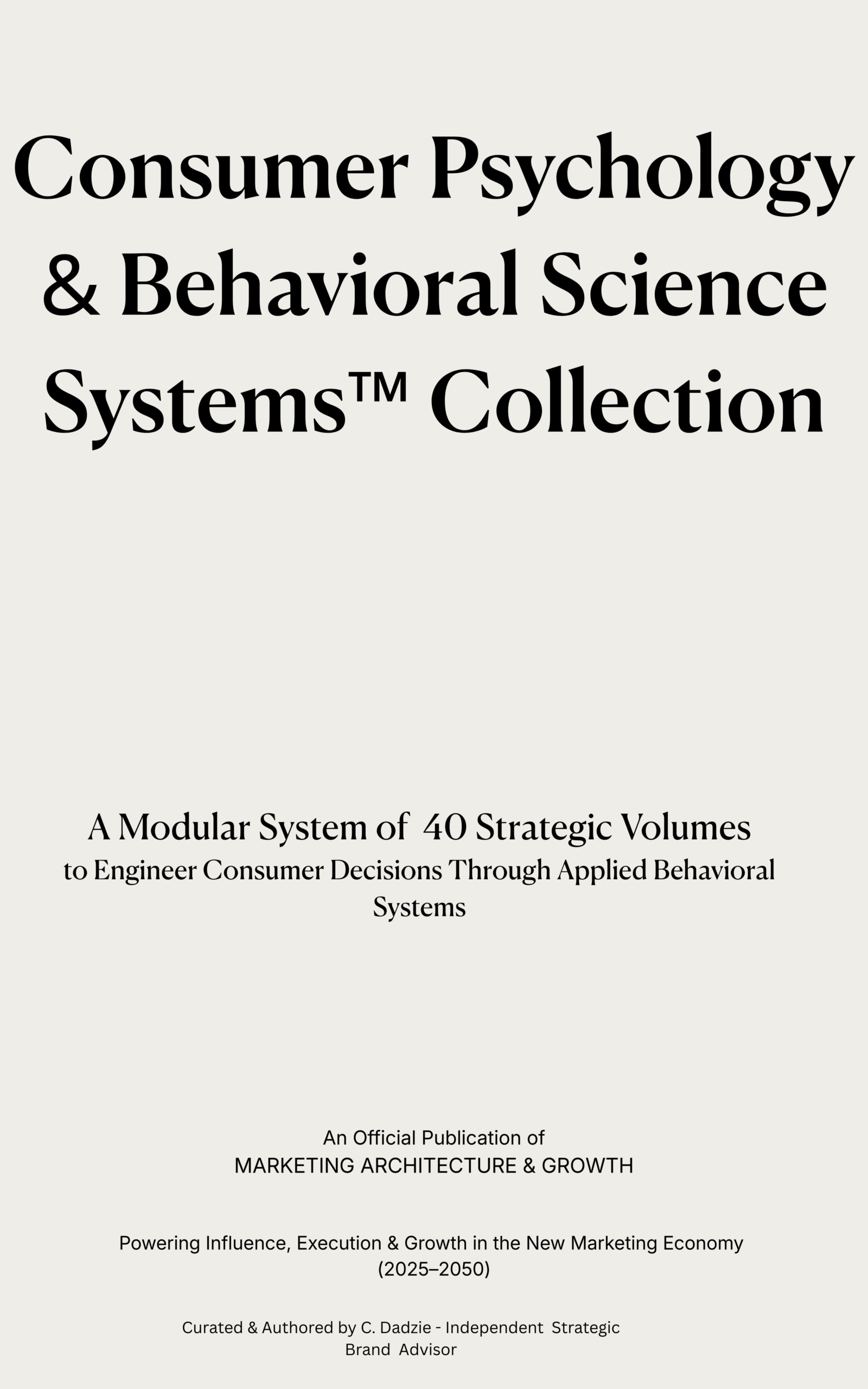
THE CONSUMER PSYCHOLOGY & BEHAVIORAL SCIENCE SYSTEMS™
Strategic Behavioral Marketing Framework
Access to this system is intentionally limited to a small number of organizations each year.
Strategic Investment: $2,900
• One-time payment
• Lifetime system license
• Immediate access upon purchase
• Full framework and methodology access
• All future updates included
• Designed for executives and organizations
Level: Strategic Advisory
Format: Digital Access
THE CONSUMER PSYCHOLOGY & BEHAVIORAL SCIENCE SYSTEMS™
is not a course about marketing tactics.
It is a strategic framework for understanding why consumers make decisions.
🔒Secure payment processing. All transactions are encrypted and protected.
Instant access is provided immediately after purchase.
Lorem ipsum dolor sit amet, consectetur adipiscing elit. Ut elit tellus, luctus nec ullamcorper mattis, pulvinar dapibus leo.
Most marketing programs teach tactics.
This system focuses on something far more valuable:
how consumers actually make decisions.
Understanding behavioral psychology allows businesses to improve one of the most important variables in any company:
conversion.
Even small improvements in conversion rates can produce significant financial impact.
Consider a simple example.
A company receives 10,000 website visitors per month.
If its current conversion rate is 1.5%, it generates:
150 customers.
If behavioral optimization increases conversion to 2.5%, the result becomes:
250 customers.
That is 100 additional customers per month without increasing advertising spend.
Over time, this improvement can represent hundreds of thousands of euros in additional revenue.
The value of understanding behavioral psychology therefore compounds over time.
Companies spend significant budgets on marketing activities such as:
• advertising campaigns
• branding projects
• marketing agencies
• consulting engagements
A single consulting engagement with a senior strategist often costs between:
€5,000 — €25,000+
Elite consulting firms charge significantly more.
What clients are actually paying for is strategic clarity.
Understanding the psychological structure behind consumer decisions can influence every marketing initiative that follows.
When businesses lack behavioral insight, they often experience:
• low conversion rates
• unclear messaging
• ineffective positioning
• wasted advertising budgets
Many companies attempt to solve these problems by simply increasing promotion.
However, promotion without psychological alignment rarely improves results.
The price reflects the strategic value of the frameworks, not the time required to consume the material.
This system provides structured insight into:
• consumer psychology
• behavioral science in marketing
• perception and positioning
• trust architecture
• decision-making triggers
These principles apply across industries and remain valuable throughout an entire career in marketing, strategy, or consulting.
The ideas inside this framework draw from disciplines such as:
• behavioral economics
• consumer psychology
• decision science
• brand strategy
• market positioning
These are the same fields studied in MBA programs and executive strategy education.
However, those programs often cost tens of thousands of euros.
Tactics change quickly.
Platforms evolve.
Algorithms shift.
But the psychology of human decision-making remains relatively stable.
Understanding these psychological principles allows professionals to adapt to any platform, industry, or marketing environment.
This is why strategic frameworks are significantly more valuable than tactical techniques.
For consultants, founders, and marketing professionals, the real value of this system lies in its ability to influence:
• messaging clarity
• positioning strategy
• customer perception
• conversion optimization
Even a small improvement in these areas can easily exceed the €2,900 investment many times over.
The real asset is not the program itself.
It is the mental framework you develop for analyzing markets, brands, and consumer behavior.
Once you understand how psychological positioning works, you begin to see marketing differently.
And that perspective becomes a long-term strategic advantage.
THE CONSUMER PSYCHOLOGY & BEHAVIORAL SCIENCE SYSTEMS™
Strategic Behavioral Marketing Framework
Access to this system is intentionally limited to a small number of organizations each year.
Strategic Investment: $2,900
• One-time payment
• Lifetime system license
• Immediate access upon purchase
• Full framework and methodology access
• All future updates included
• Designed for executives and organizations

Level: Strategic Advisory
Format: Digital Access
We use cookies and similar technologies to ensure the proper functioning of this website, to analyze traffic, and to improve your experience.
You can accept all cookies, reject non-essential cookies, or customize your preferences at any time.