
|
🚧 Marketingadss is currently being redesigned to better serve you. Online services and purchases will be available soon.
|
€ 4200
The future of work is not flexible.
The future of the economy is not digital.
They are restructured.
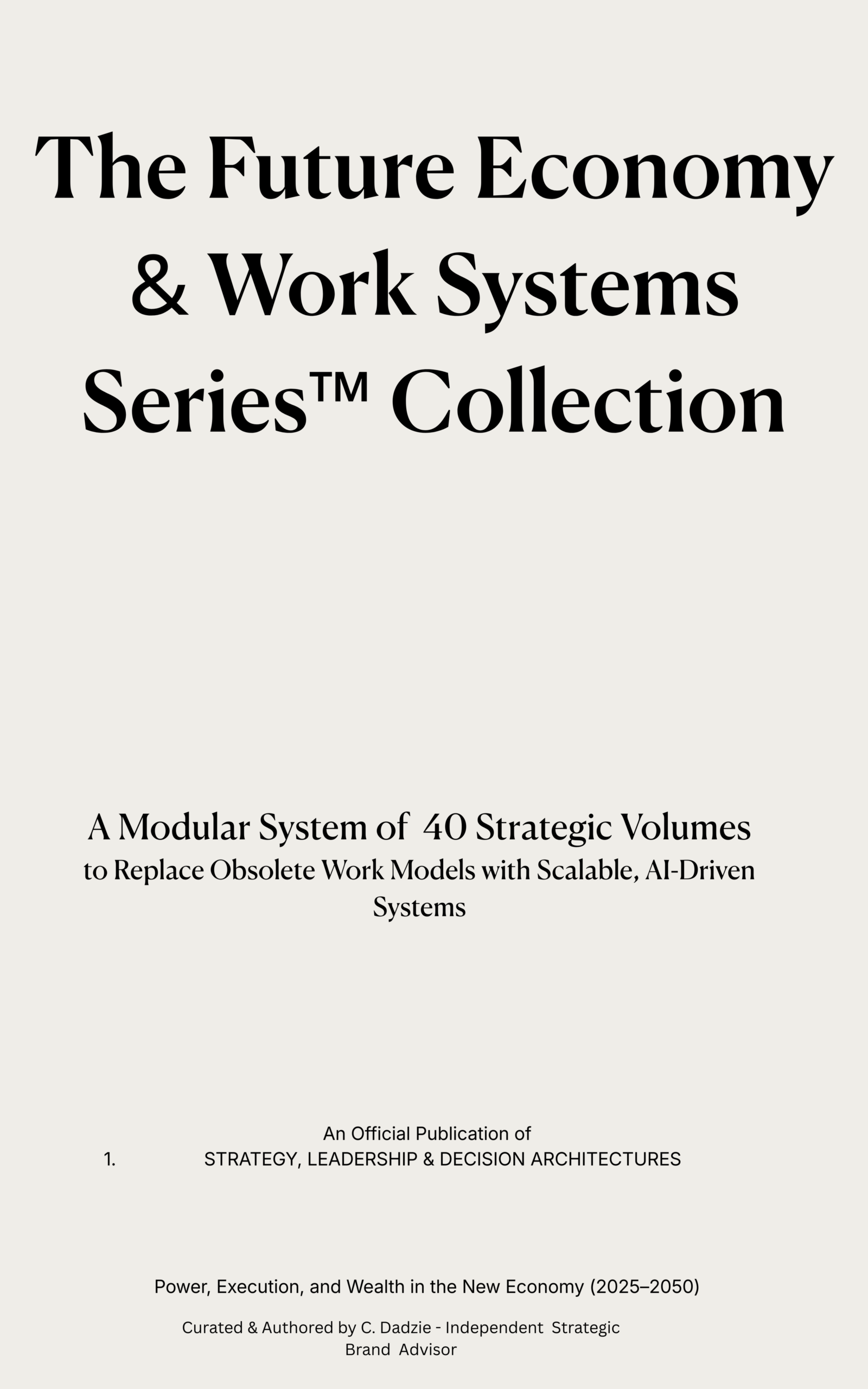
The Future Economy & Work Systems Series™ is a practical system for understanding — and positioning yourself inside — the economic architectures that are replacing employment, careers, and traditional value creation.
Without this collection, you adapt too late.
With it, you anticipate structurally.
What you lose without it:
You prepare for a future that no longer exists.
“Applied by 120+ strategists”
“Used in 7 markets”
“Tested across 4 industries”
A structured methodology to align leadership,
redesign decision architecture and accelerate execution.
Siemens successfully evolved from a traditional
engineering company into a leader in industrial automation.
This transformation required:
• strategic portfolio redesign
• digital infrastructure investments
• organizational restructuring
Siemens successfully evolved from a traditional
engineering company into a leader in industrial automation.
This transformation required:
• strategic portfolio redesign
• digital infrastructure investments
• organizational restructuring
Large organizations must periodically redesign
their strategic architecture to remain competitive.
Large organizations must periodically redesign
their strategic architecture to remain competitive.
1. Strategic Deconstruction
Identifying structural barriers to execution.
2. Decision Architecture
Redesigning how strategic decisions are made.
3. Organizational Alignment
Aligning leadership structures and incentives.
4. Strategic Adaptability
Building systems capable of responding to change.
• leadership misalignment
• slow decision cycles
• organizational complexity
• strategy disconnected from execution
It fails because organizations cannot execute them.
This system is built on years of research into
organizational strategy, leadership alignment and
decision architecture inside complex organizations.
Phase 1 — Strategic Diagnostic
Analyzing organizational execution barriers.
Phase 2 — Leadership Alignment
Aligning leadership teams around strategic priorities.
Phase 3 — Decision Architecture
Redesigning how strategic decisions are made.
Phase 4 — Execution Acceleration
Implementing new strategic operating principles.
Company Type: Professional services firm
Industry: Consulting / advisory / digital transformation
Region: Europe
Employees: 85
Revenue: €9.5M annually
Despite strong expertise and demand:
👉 Problem:
the company was operating with outdated work models in a changing economy
The issue was not:
But:
👉 an obsolete operating system for work execution
Deployment of
Future Economy & Work Systems™
👉 Objective: remove unnecessary friction
👉 Objective: augment human output
👉 Objective: scale without adding headcount
👉 Objective: increase speed exponentially
The company didn’t grow by:
But by:
👉 changing how work itself is structured and executed
Shift from:
To:
👉 system-driven production engine
Before:
After:
👉 work = systems × leverage
In the new economy:
👉 systems are the new workforce
Companies that fail to redesign their work models will:
While others:
👉 scale faster with fewer people and higher output
⭐⭐⭐⭐⭐
Challenge
Our leadership team was struggling to understand how AI and automation would impact our workforce and long-term business model.
What we implemented
We applied the future workforce and economic transition frameworks from this collection to redesign our organizational planning.
Result
The new perspective helped us identify several structural opportunities in how we organize talent and technology. It allowed us to prepare our company for long-term economic shifts rather than reacting to them later.
Emma W. — Economic Strategy Advisor — Amsterdam
Frameworks applied
• Future Workforce Architecture
• Economic Transition Framework
• Human-Machine Collaboration Model
Application context
• Technology consulting firm
• Leadership strategy team
• European market
⭐⭐⭐⭐⭐
Challenge
Our company was expanding rapidly but we lacked a clear understanding of how remote work, automation and digital talent markets were reshaping the future of work.
What we implemented
The strategic frameworks in this collection helped us rethink how teams should operate in an AI-driven environment.
Result
We redesigned several internal processes and talent structures which significantly improved collaboration and operational flexibility across our organization.
Daniel C. — Operations Manager — Toronto
Frameworks applied
• Hybrid Workforce Framework
• Distributed Organization Model
• Talent Infrastructure Strategy
Application context
• Digital services company
• 40-person team
• North American market
⭐⭐⭐⭐⭐
Challenge
Our company was investing in technology but without a clear long-term vision of how economic systems are evolving.
What we implemented
After studying the macroeconomic and technology transition models presented in this collection, we introduced a strategic roadmap for how our business should evolve over the next decade.
Result
The clarity gained from these frameworks helped us focus our investments on future-relevant capabilities rather than short-term trends.
Lucas M. — Innovation Director — Barcelona
Frameworks applied
• Economic Evolution Framework
• Future Market Mapping
• Technology Transition Model
Application context
• Corporate innovation team
• European market
• Strategy department
Business in 2050 — How the Next Era Will Transform Everything
AI-Driven Economies — Competing in a Machine-Led World
The Future of Capitalism — Systems That Will Replace Today
The Next Industrial Revolution — AI, Robotics & Society
The Future of Global Markets — Where the Money Flows Next
The Post-Employee Company — Automation, Agents & New Workforce
Human + Machine — The Future of Collaboration
The Intelligent Company — AI as a Strategic Partner
The Hybrid Workplace — Work Anywhere, Achieve More
Decentralized Business Models — Web3, Ownership & New Markets
Digital Nations — The Rise of Cloud Countries & Virtual Economies
The End of Competition — The Rise of Ecosystem Thinking
The Business of Truth — Surviving in a Deepfake Society
The Future Consumer — Behaviors That Will Dominate 2050
Humanity in Business — The Values That Will Shape the Next Era
Access to this system is intentionally limited to a small number of organizations each year.
Strategic Investment: $4,200
• One-time payment
• Lifetime system license
• Immediate access upon purchase
• Full framework and methodology access
• All future updates included
• Designed for executives and organizations
Level: Strategic Advisory
Format: Digital Access
🔒Secure payment processing. All transactions are encrypted and protected.
Instant access is provided immediately after purchase.
THE FUTURE ECONOMY & WORK SYSTEMS™
is not about productivity tools.
It is a strategic framework for understanding the economic infrastructure of work in the 21st century.
Price: $4,200
Theme: Strategy • Future of Work • Economic Systems
The global economy is entering a structural transformation.
For more than a century, organizations were designed around the industrial model of work:
• centralized offices
• hierarchical decision structures
• linear production systems
Today, this model is rapidly becoming obsolete.
Three powerful forces are reshaping how economic value is created:
• Artificial Intelligence
• Digital Platforms
• Distributed Work Systems
These forces are not simply technological trends.
They are architectural shifts in how organizations function.
In the emerging economy:
• work is increasingly digital
• collaboration is global
• productivity is amplified by automation
The companies that understand these structural changes will design the next generation of economic infrastructure.
Those that do not will struggle to remain competitive.
THE FUTURE ECONOMY & WORK SYSTEMS™ explores the strategic architecture required to operate in this new environment.
It is not a theory of productivity.
It is a systems framework for the next era of work.
Many organizations are still operating with management systems designed for the industrial age.
These systems were built for:
• factory production
• physical offices
• linear workflows
But the modern economy now depends on entirely different dynamics.
Today’s organizations rely on:
• knowledge workers
• digital platforms
• automated systems
• distributed collaboration
As a result, many companies experience structural inefficiencies:
• slow decision-making
• fragmented communication
• productivity loss
• talent attrition
The challenge facing leaders today is no longer simply hiring the right people.
The real challenge is designing systems of work that enable people to perform at scale.
In the modern economy, organizational architecture determines economic performance.
Without a clear system for designing work, organizations become operationally chaotic.
The transformation of work can be understood through a simple structural principle:
Economic productivity = Organizational systems × Knowledge performance
Companies that align these elements create exponential leverage.
Those that ignore them remain constrained by outdated operational models.
The Future Economy Framework™ provides a structured model for designing organizations built for the next economic era.
Future organizations rely on digital operational infrastructure.
This includes:
• collaboration platforms
• integrated data systems
• workflow automation tools
Digital infrastructure enables coordination at scale.
Without it, growth creates complexity instead of efficiency.
The modern workforce is increasingly distributed across locations and time zones.
Organizations must design systems that support:
• remote collaboration
• global talent integration
• asynchronous workflows
Companies that master distributed work unlock global productivity networks.
In the modern economy, knowledge workers generate the majority of economic value.
However, knowledge productivity is often poorly managed.
Future organizations must optimize:
• decision-making systems
• information flow
• cognitive performance
The objective is not simply more work.
It is better thinking at scale.
Markets are evolving faster than ever.
Companies must adapt quickly to new opportunities and threats.
Agile organizations rely on:
• flexible teams
• rapid experimentation
• decentralized decision-making
Agility is no longer optional.
It is a core competitive advantage.
Leadership itself is evolving.
Traditional leadership focused on managing people.
Future leadership focuses on designing systems.
Modern leaders must think like organizational architects, structuring environments where high performance emerges naturally.
Even without client case studies, strategic insight can be demonstrated by analyzing global companies that have successfully built large-scale operational systems.
Three examples illustrate the principles of modern organizational architecture.
Coca-Cola operates in more than 200 countries.
To sustain this scale, the company coordinates:
• global supply chains
• regional marketing strategies
• local distribution networks
The scale of Coca-Cola is not simply the result of marketing success.
It is the result of deeply structured organizational systems.
These systems allow:
• global brand consistency
• regional strategic adaptation
• local operational execution
Future organizations must balance:
• global coordination
• local autonomy
• digital operational infrastructure
PepsiCo integrates multiple large-scale operational ecosystems including:
• food production
• beverage manufacturing
• global logistics
The future economy rewards organizations capable of managing complex operational ecosystems.
Operational integration enables companies to coordinate multiple business units while maintaining strategic alignment.
Red Bull transformed itself from a beverage company into a media ecosystem.
The brand integrates:
• sports marketing
• media production
• global brand communities
In the future economy, companies increasingly operate as platform ecosystems rather than single-product businesses.
Many organizations experience structural friction:
• slow decision processes
• fragmented communication
• inefficient collaboration
• limited adaptability
These challenges are often caused by outdated management models.
The result is operational complexity without corresponding productivity.
Organizations that redesign their work systems experience major structural improvements:
• faster collaboration across teams
• improved knowledge productivity
• greater organizational agility
• scalable operational infrastructure
Work becomes strategically structured rather than operationally chaotic.
Productivity improvements create significant economic leverage.
This relationship can be expressed through a simple economic model:
Revenue Growth = Productivity × Organizational Efficiency
Company revenue: $5M
If improved work systems increase productivity by 15–20%, the company may generate substantial growth without increasing headcount.
Instead of scaling through hiring, organizations scale through better systems.
This is the power of organizational architecture.
Strategic Framework for the Next Economic Era
This program delivers a systems-level understanding of how modern organizations operate and scale in a digital economy.
Inside the framework you will learn:
• how to design high-performance work systems
• how distributed organizations operate at scale
• how digital infrastructure transforms productivity
• how leaders become architects of organizational systems
This is not a productivity course.
It is a strategic architecture for the future of work.
$4,200
For leaders, strategists, consultants, and founders who want to understand how organizations will operate in the next economic era.
Executive Strategic Access — €4,200
Lorem ipsum dolor sit amet, consectetur adipiscing elit. Ut elit tellus, luctus nec ullamcorper mattis, pulvinar dapibus leo.
Designed for professional and institutional use.
No. It provides structural frameworks directly applicable to strategic decision-making.
Secure digital access is provided immediately after confirmation.
Yes, structural updates are integrated within the access scope.
01. Business in 2050 — How the Next Era Will Transform Everything.
02. AI-Driven Economies — Competing in a Machine-Led World.
03. The Future of Capitalism — Systems That Will Replace Today.
04. The Future of Global Markets — Where the Money Flows Next.
05. The Post-Employee Company — Automation, Agents & New Workforce.
06. The Intelligent Company — AI as a Strategic Partner.
07. The End of Competition — The Rise of Ecosystem Thinking.
08. Human + Machine — The Future of Collaboration.
09. The Hybrid Workplace — Work Anywhere, Achieve More.
010. Decentralized Business Models — Web3, Ownership & New Markets.
011. The Next Industrial Revolution — AI, Robotics & Society.
012. Digital Nations — The Rise of Cloud Countries & Virtual Economies.
013. The Business of Truth — Surviving in a Deepfake Society.
014. The Future Consumer — Behaviors That Will Dominate 2050.
015. Humanity in Business — The Values That Will Shape the Next Era.
Executive Strategic Access — €4,200
Serious strategic frameworks are not priced like information products.
They are priced according to the economic value of the thinking they enable.
THE FUTURE ECONOMY & WORK SYSTEMS™ is not a productivity course or a set of tools.
It is a strategic architecture for understanding how organizations will operate in the next economic era.
For leaders, founders, and consultants, the cost of misunderstanding these systems is far greater than the cost of learning them.
In executive consulting, strategy is valued based on leverage, not time.
A single structural improvement in how an organization operates can impact:
• productivity
• speed of execution
• team performance
• decision-making quality
• long-term scalability
Even small improvements in these areas create massive economic effects.
Example scenario:
Company revenue: €3M – €10M
If improved work systems increase productivity by 10–20%, the financial impact can easily represent hundreds of thousands of euros annually.
Compared to that scale of impact, €4,200 is not a cost.
It is a strategic investment in organizational leverage.
Most online programs sell information.
Elite strategy frameworks deliver mental infrastructure.
Information tells you what to do.
Strategic frameworks show you how systems actually work.
Once you understand the structure of modern organizations:
• you see inefficiencies instantly
• you identify leverage points faster
• you design better systems
That kind of thinking compounds over years.
Senior strategy consultants, organizational designers, and management advisors typically charge:
• €2,000 – €5,000 per day
• €20,000 – €100,000 per strategic project
And that pricing only reflects temporary advisory access.
THE FUTURE ECONOMY & WORK SYSTEMS™ gives you the core strategic frameworks used to analyze and design modern organizations.
Accessible permanently.
Without consulting retainers.
Many organizations unknowingly lose enormous value due to outdated work structures:
• inefficient communication
• slow decision processes
• poorly designed workflows
• fragmented digital infrastructure
These inefficiencies silently drain productivity every day.
The real risk is not investing in strategy.
The real risk is continuing to operate with outdated organizational systems.
The leaders who dominate the next decade will not simply work harder.
They will design better systems.
They will understand:
• digital operational infrastructure
• distributed workforce architecture
• knowledge productivity systems
• agile organizational design
This program is designed to provide that strategic clarity.
The €4,200 investment is intentional.
This framework is designed for individuals who think at the level of:
• strategy
• systems
• economic architecture
Not casual learning.
Serious strategic thinking requires serious commitment.
The real question is not:
“Is €4,200 expensive?”
The real question is:
What is the economic cost of operating without modern work systems in the next decade?
For leaders shaping organizations in the digital economy, the answer is obvious.
THE FUTURE ECONOMY & WORK SYSTEMS™
Strategic Framework for the Next Economic Infrastructure of Work
Investment: €4,200
For founders, executives, consultants, and strategic thinkers building organizations designed for the future economy.
How AI Will Reinvent the Art of Advertising.
Lorem ipsum dolor sit amet, consectetur adipisi cing elit, sed do eiusmod tempor incididunt ut abore et dolore magna
Lorem ipsum dolor sit amet, consectetur adipisi cing elit, sed do eiusmod tempor incididunt ut abore et dolore magna
We use cookies and similar technologies to ensure the proper functioning of this website, to analyze traffic, and to improve your experience.
You can accept all cookies, reject non-essential cookies, or customize your preferences at any time.