
|
🚧 Marketingadss is currently being redesigned to better serve you. Online services and purchases will be available soon.
|
€ 3200
Entrepreneurship is not about ideas.
Innovation is not about creativity.
They are about structural advantage.
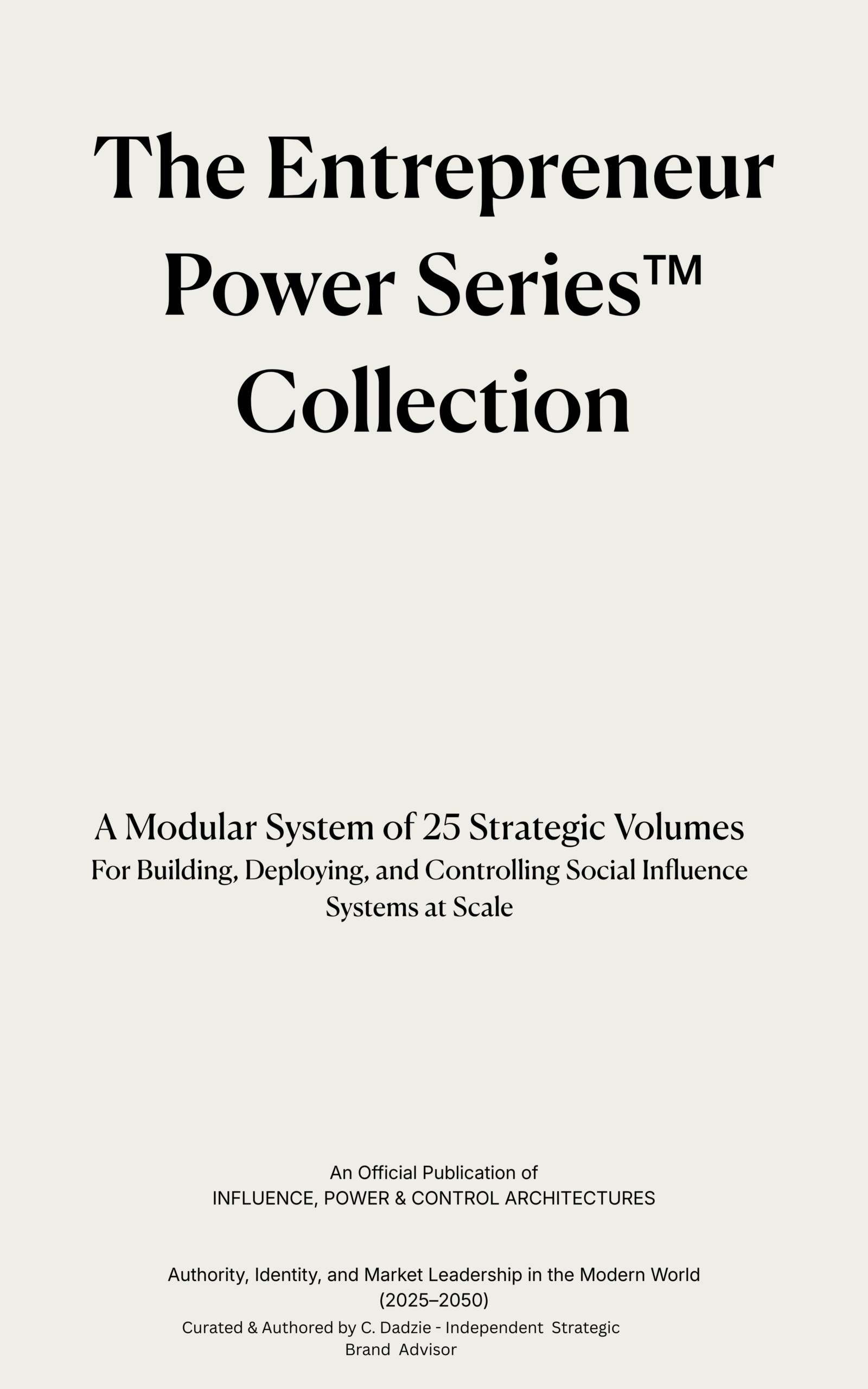
The Entrepreneurship & Innovation Systems Series™ is a practical execution system for repeatedly creating value where others only generate noise.
Without this collection, innovation stays fragile.
With it, innovation becomes systemic.
What you lose without it:
You rely on intuition, timing, and luck — instead of repeatable advantage.
“Applied by 120+ strategists”
“Used in 7 markets”
“Tested across 4 industries”
This collection operates within the Foundational Axiom established by the Institute.
Innovation is not invention.
It is the reconfiguration of what others consider fixed.
A structured methodology to align leadership,
redesign decision architecture and accelerate execution.
Siemens successfully evolved from a traditional
engineering company into a leader in industrial automation.
This transformation required:
• strategic portfolio redesign
• digital infrastructure investments
• organizational restructuring
Large organizations must periodically redesign
their strategic architecture to remain competitive.
Siemens successfully evolved from a traditional
engineering company into a leader in industrial automation.
This transformation required:
• strategic portfolio redesign
• digital infrastructure investments
• organizational restructuring
Siemens successfully evolved from a traditional
engineering company into a leader in industrial automation.
This transformation required:
• strategic portfolio redesign
• digital infrastructure investments
• organizational restructuring
Large organizations must periodically redesign
their strategic architecture to remain competitive.
1. Strategic Deconstruction
Identifying structural barriers to execution.
2. Decision Architecture
Redesigning how strategic decisions are made.
3. Organizational Alignment
Aligning leadership structures and incentives.
4. Strategic Adaptability
Building systems capable of responding to change.
• leadership misalignment
• slow decision cycles
• organizational complexity
• strategy disconnected from execution
It fails because organizations cannot execute them.
This system is built on years of research into
organizational strategy, leadership alignment and
decision architecture inside complex organizations.
Phase 1 — Strategic Diagnostic
Analyzing organizational execution barriers.
Phase 2 — Leadership Alignment
Aligning leadership teams around strategic priorities.
Phase 3 — Decision Architecture
Redesigning how strategic decisions are made.
Phase 4 — Execution Acceleration
Implementing new strategic operating principles.
Industry: Personal Brand / Business Education
Region: Europe / Middle East
Annual Revenue: $2.1M
Team Size: 9 people
Despite strong expertise, the founder was stuck:
👉 The problem wasn’t skill.
👉 It was lack of power architecture
A deep analysis revealed:
👉 The founder was operating without influence systems
Instead of creating more content…
👉 The founder built a power and influence system
The bottleneck was not visibility.
👉 It was lack of structured influence and power systems
By applying the frameworks from the
Entrepreneur Power Series™ Collection
The founder shifted from:
→ Posting content
To:
→ Building strategic influence at scale
Result:
👉 Stronger authority
👉 Higher perceived value
👉 Scalable revenue growth
From:
→ Content creator
To:
→ Market authority
Most entrepreneurs:
Very few:
👉 Build systems of influence, power, and control
Influence is not luck.
👉 It is engineered.
When:
👉 power becomes scalable
⭐⭐⭐⭐⭐
Challenge
As a founder I was focused on building products and generating revenue, but I realized I lacked a deeper understanding of leverage and power dynamics in business.
What we implemented
After studying the entrepreneurial power frameworks in this collection, I redesigned how I evaluate opportunities, partnerships and strategic positioning.
Result
The shift helped me focus on initiatives that create long-term leverage rather than short-term activity. It significantly improved how I approach business growth and strategic decisions.
Nathan G. — Startup Founder — Singapore
Frameworks applied
• Entrepreneurial Leverage Framework
• Strategic Power Mapping
• Opportunity Control Model
Application context
• Technology startup
• Founder-led company
• Asian market
⭐⭐⭐⭐⭐
Challenge
Our company was growing, but we were constantly reacting to competitors instead of shaping the direction of our market.
What we implemented
Using the strategic power frameworks from this collection, we redesigned our market positioning and long-term growth strategy.
Result
The change helped us move from reactive competition to proactive market leadership, focusing on initiatives that strengthen our strategic influence.
Laura M. — Business Strategy Director — London
Frameworks applied
• Market Influence Framework
• Strategic Leverage Model
• Entrepreneurial Power Architecture
Application context
• Growth-stage company
• Leadership team
• European market
⭐⭐⭐⭐⭐
Challenge
Our entrepreneurial projects were moving forward, but we lacked a clear system for identifying the highest-impact opportunities.
What we implemented
The power and leverage models in this collection helped us create a structured decision framework for evaluating new ventures.
Result
This new perspective allowed us to prioritize projects that generate real strategic advantage rather than incremental growth.
Lucas M. — Venture Advisor — Barcelona
Frameworks applied
• Opportunity Leverage Model
• Strategic Control Framework
• Entrepreneurial Decision Architecture
Application context
• Venture studio
• Startup founders
• European market
The Ultimate Founder — What It Really Takes to Build Great Companies
The Founder’s DNA — Traits That Predict Massive Success
The Founder’s Mindset — Thinking Like a Billion-Dollar Creator
Startup Psychology — Winning the Mental Game
The Entrepreneurial Brain — Cognitive Tools for Builders
The Relentless Builder — Grit, Obsession & the Pursuit of Mastery
The Idea Machine — How to Create Business Opportunities Continuously
The Next Billion-Dollar Ideas — Trends for the Next 25 Years
Think Like a Creator — Turning Imagination Into Wealth
Impossible Startups — Building What the World Thinks You Can’t
The Disruptor’s Edge — Breaking Markets With Bold Ideas
Startup Mastery — Systems for Predictable Growth
Startup Systems — Blueprint for Scalable Processes
The Lean Empire — Building Big With Small Resources
Building in Public — Growing Faster With Transparency
Creation at Scale — Building Multiple Businesses at Once
The Execution Factor — Ideas Are Cheap, Execution Wins
The Execution Machine — Building Teams That Deliver
Build Fast, Build Smart — The Art of Rapid Innovation
The Adaptive Business — Thriving in Constant Change
The New Age Entrepreneur — Blending Tech, Psychology & Culture
Creating Market Momentum — Making Your Startup Unstoppable
Breakthrough Businesses — How Disruptors Change the Game
The High-Leverage Founder — Outsized Impact With Less Effort
Entrepreneurial Greatness — How to Outperform Everyone
Innovate or Die — Reinvention as a Survival Strategy
Reinvent Everything — The Mindset of Perpetual Innovation
The Reinvention Cycle — How Top Companies Stay Relevant
Futureproof Startups — Building for a 30-Year Horizon
The Future Entrepreneur — Skills Needed for a Post-AI Era
The 100-Year Company — Designing Businesses That Last Generations
The Future Founder’s Guide — Winning in a New Economic Landscape
The Entrepreneur of Tomorrow — Vision, Speed & Intelligence
Zero to Infinity — Scaling Ideas Beyond Imagination
The Anti-Fragile Business — Growing Stronger Through Chaos
AI-Proof Innovation — Reducing Risk in Creative Decisions
Startups in the Age of AI — Launching Businesses With Machine Power
The Innovative Leader — Guiding Teams Into the Future
The Serial Founder — Systems for Repeated Success
Access to this system is intentionally limited to a small number of organizations each year.
Strategic Investment: $3,200
• One-time payment
• Lifetime system license
• Immediate access upon purchase
• Full framework and methodology access
• All future updates included
• Designed for executives and organizations
Level: Strategic Advisory
Format: Digital Access
🔒Secure payment processing. All transactions are encrypted and protected.
Instant access is provided immediately after purchase.
THE ENTREPRENEURSHIP & INNOVATION SYSTEMS™
is not a startup course.
It is a strategic framework for understanding how entrepreneurs design innovative business models, scalable systems, and long-term growth strategies.
Price: $3,200
Theme: Entrepreneurship • Innovation • Strategic Growth
The most successful companies of the modern economy did not simply build better products.
They reinvented entire business systems.
Uber restructured transportation.
Airbnb redesigned hospitality.
Booking.com optimized digital distribution at global scale.
Their advantage was not only technology.
It was strategic architecture.
They redesigned how markets function.
The Entrepreneurship & Innovation Systems™ framework reveals the underlying structure behind these transformations.
It is designed for entrepreneurs, founders, and strategic thinkers who want to understand:
• how disruptive companies are built
• how innovation creates new markets
• how scalable systems generate exponential growth
This is not a tactical startup course.
It is a strategic framework for designing innovative businesses.
Many startups fail not because their ideas are bad.
They fail because their business systems are weak.
Common problems include:
• unclear business models
• lack of scalable infrastructure
• slow experimentation cycles
• weak market positioning
Founders often focus heavily on products.
But the most successful companies innovate at a deeper level:
the structure of the business itself.
Without a scalable architecture, even great ideas struggle to grow.
Innovation must become systematic.
Innovative companies follow structural principles.
They combine market insight, scalable systems, and rapid experimentation.
This creates a repeatable innovation engine.
At the core of the framework are five strategic pillars.
Innovation begins with understanding market inefficiencies.
Entrepreneurs must identify:
• structural gaps in existing markets
• underserved customer segments
• untapped economic opportunities
Markets reveal where innovation can create the most value.
The business model determines how value is created and captured.
Successful innovators redesign:
• pricing structures
• platform ecosystems
• distribution models
Often, the business model matters more than the product.
Innovative companies design systems that grow without proportional costs.
This includes:
• digital platforms
• automation systems
• scalable global distribution
Infrastructure determines whether innovation can scale.
Innovation requires constant testing.
Leading organizations develop:
• structured experimentation frameworks
• fast feedback loops
• data-driven decision systems
Speed of learning becomes a competitive advantage.
Innovation must eventually translate into market dominance.
Entrepreneurs scale through:
• geographic expansion
• strategic partnerships
• continuous product evolution
Innovation becomes a long-term growth engine.
Instead of relying on testimonials, the framework demonstrates its logic through strategic analysis of disruptive companies.
These organizations reshaped their industries.
Current Situation
Uber disrupted transportation through:
• a digital marketplace platform
• real-time supply and demand matching
• scalable global infrastructure
Strategic Insight
Uber’s breakthrough was structural.
The company redesigned the interaction between drivers and passengers.
Instead of owning vehicles, Uber built a platform marketplace that orchestrates supply and demand at scale.
The innovation lies in the system, not just the technology.
Observation
Airbnb transformed hospitality by creating:
• a peer-to-peer accommodation network
• trust systems through reviews and ratings
• global digital distribution
Strategic Lesson
Innovation often emerges from unlocking underutilized resources.
Airbnb transformed spare rooms into a global hospitality network.
The company did not build hotels.
It built a trust infrastructure for strangers.
Diagnostic
Booking.com built global dominance through:
• massive accommodation inventory
• aggressive conversion optimization
• continuous experimentation
Strategic Insight
Innovation does not always come from radical disruption.
It can emerge from relentless optimization.
Thousands of small improvements across a platform can create enormous market advantages.
These examples demonstrate how innovative organizations redesign entire business systems.
Many entrepreneurs operate with fragmented strategies.
Their businesses experience:
• slow growth
• weak differentiation
• unstable revenue models
Even promising startups remain small because their systems cannot scale.
Businesses gain:
• scalable business models
• stronger market positioning
• faster innovation cycles
• systematic experimentation processes
Innovation becomes a repeatable competitive advantage.
Innovation directly affects financial performance.
When a company improves:
• its business model
• its market positioning
• its customer acquisition efficiency
revenue growth accelerates.
Startup annual revenue: $1,000,000
A 20% improvement in conversion rates and market adoption can generate:
+$200,000 additional annual revenue
Investment in the framework:
$3,200
The strategic leverage becomes obvious.
A small structural improvement can generate multiples of the investment.
Strategic Framework for Building Innovative and Scalable Businesses
Investment: $3,200
This executive framework reveals how innovative companies design:
• scalable business models
• platform ecosystems
• experimentation systems
• long-term growth architectures
You will learn how entrepreneurs transform ideas into scalable innovation systems.
It is a strategic architecture for entrepreneurial innovation.
Designed for:
• founders
• consultants
• strategists
• innovation leaders
Professionals who want to understand how disruptive companies are truly built.
A strategic framework for those who want to design the next generation of scalable businesses.
🔒Secure payment processing. All transactions are encrypted and protected.
Instant access is provided immediately after purchase.
Lorem ipsum dolor sit amet, consectetur adipiscing elit. Ut elit tellus, luctus nec ullamcorper mattis, pulvinar dapibus leo.
If you are evaluating this page, you are likely asking a rational question:
Why €3,200?
The answer is simple.
This is not an online course.
It is a strategic framework used to understand how innovative companies design scalable business systems.
And the value of that knowledge compounds.
Most entrepreneurs spend years trying to solve problems that originate from structural flaws:
• weak business models
• poor market positioning
• inefficient customer acquisition
• slow experimentation cycles
These mistakes are expensive.
A single incorrect strategic decision can cost tens or hundreds of thousands of euros.
Sometimes millions.
The goal of this framework is to prevent those mistakes before they occur.
Consider the price of high-level strategic education:
Executive MBA programs
€60,000 – €150,000
Elite strategy consulting
€10,000 – €100,000+
Private innovation consulting sessions
€2,000 – €5,000 per day
Compared to these standards, the investment is modest.
This framework distills years of strategic research on innovation systems into a structured architecture.
Entrepreneurship is not linear.
It is leverage-based.
One improvement in a key system can multiply revenue.
Example:
A company generating €1M annually improves its market positioning and conversion rate by 20%.
That improvement alone may generate:
+€200,000 per year
The investment in the framework:
€3,200
Strategic leverage makes the comparison obvious.
Most online programs are priced between €200 and €500.
They typically offer:
• tactical information
• fragmented advice
• short-term strategies
This framework is different.
It focuses on business architecture, not tactics.
It explains how innovative companies design entire systems.
That level of thinking belongs to executive strategy, not entry-level training.
Serious entrepreneurs understand a simple truth:
Low prices attract casual attention.
High prices attract serious builders.
The price reflects three elements:
• strategic depth
• intellectual property
• long-term business leverage
This framework was designed for professionals who want to think at the level of business architecture.
This framework is designed for individuals who are building:
• startups
• consulting firms
• digital platforms
• scalable companies
It is particularly valuable for:
• entrepreneurs
• consultants
• innovation strategists
• business architects
Professionals who understand that strategic clarity compounds over time.
A strong business system can generate revenue for years.
Understanding how innovative companies design those systems is one of the most valuable skills in entrepreneurship.
The investment:
€3,200
The potential leverage:
unlimited.
Strategic architecture for building innovative and scalable businesses.
🔒Secure payment processing. All transactions are encrypted and protected.
Instant access is provided immediately after purchase.
We use cookies and similar technologies to ensure the proper functioning of this website, to analyze traffic, and to improve your experience.
You can accept all cookies, reject non-essential cookies, or customize your preferences at any time.