
|
🚧 Marketingadss is currently being redesigned to better serve you. Online services and purchases will be available soon.
|
€ 4800
This collection is built for people who no longer need motivation, advice, or inspiration —
but strategic authority.
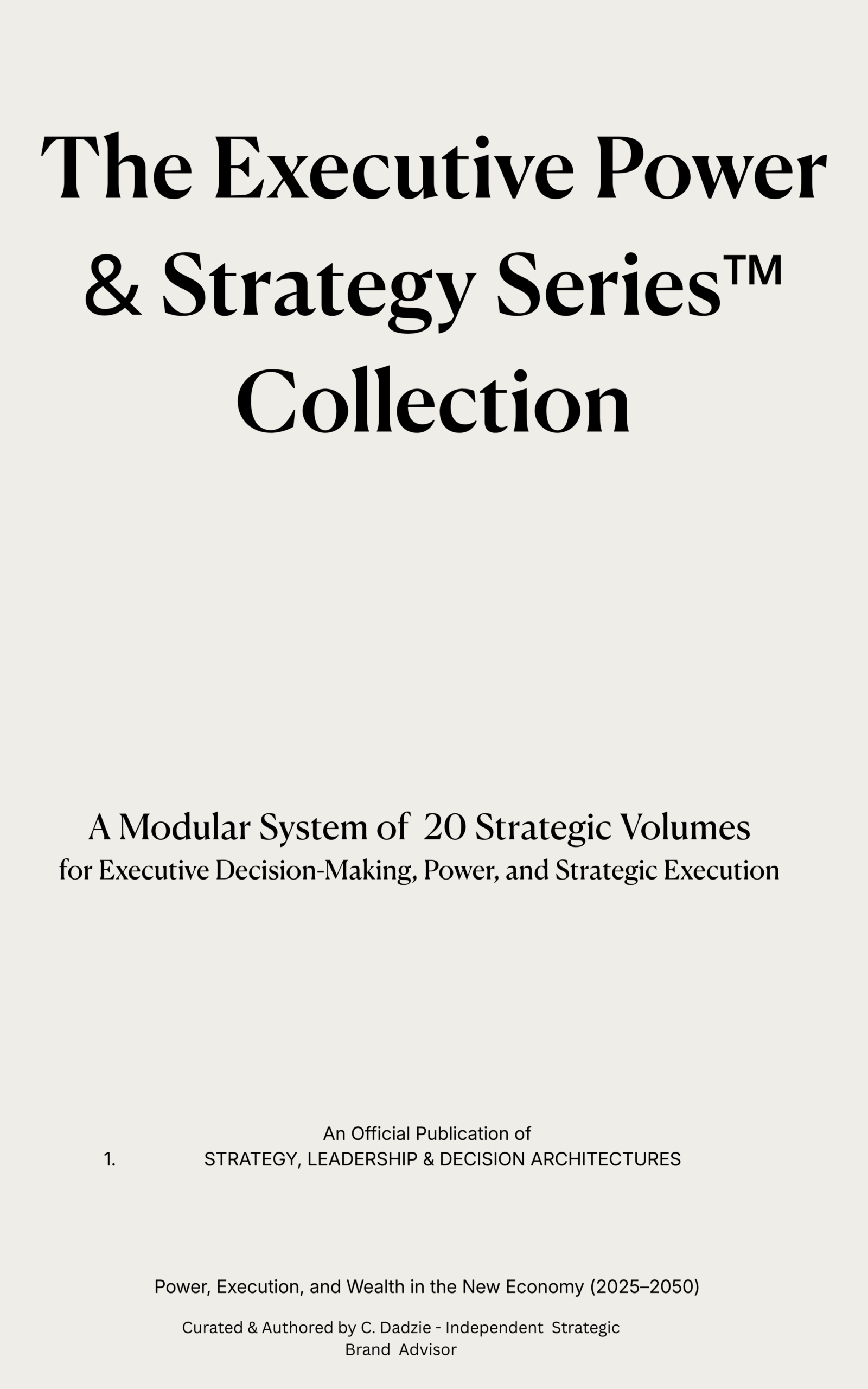
The Executive Power & Strategy Series™ gives you the decision frameworks, power mechanics, and control architectures used at the highest levels of leadership, governance, and influence.
If you are responsible for outcomes — not opinions — this collection is not optional.
What you lose without it:
You continue to react, delegate blindly, and decide with incomplete leverage while others structure the game above you.
“Applied by 120+ strategists”
“Used in 7 markets”
“Tested across 4 industries”
This collection operates within the Foundational Axiom established by the Institute.
Power is not decision-making speed.
It is the ability to define which decisions never need to be made.
A structured methodology to align leadership,
redesign decision architecture and accelerate execution.
Siemens successfully evolved from a traditional
engineering company into a leader in industrial automation.
This transformation required:
• strategic portfolio redesign
• digital infrastructure investments
• organizational restructuring
Large organizations must periodically redesign
their strategic architecture to remain competitive.
1. Strategic Deconstruction
Identifying structural barriers to execution.
2. Decision Architecture
Redesigning how strategic decisions are made.
3. Organizational Alignment
Aligning leadership structures and incentives.
4. Strategic Adaptability
Building systems capable of responding to change.
• leadership misalignment
• slow decision cycles
• organizational complexity
• strategy disconnected from execution
It fails because organizations cannot execute them.
This system is built on years of research into
organizational strategy, leadership alignment and
decision architecture inside complex organizations.
Phase 1 — Strategic Diagnostic
Analyzing organizational execution barriers.
Phase 2 — Leadership Alignment
Aligning leadership teams around strategic priorities.
Phase 3 — Decision Architecture
Redesigning how strategic decisions are made.
Phase 4 — Execution Acceleration
Implementing new strategic operating principles.
Company Type: Mid-market technology company
Industry: SaaS / B2B infrastructure
Region: Europe & North America
Revenue: €18M annually
Leadership: Founder-CEO + executive team
The company had:
But faced a critical bottleneck:
👉 decision-making inefficiency at the executive level
👉 Problem:
the company was growing — but leadership velocity was not
The issue was not:
But:
👉 lack of structured decision architecture
Deployment of
Executive Power & Strategy Systems™
👉 Objective: accelerate clarity and reduce friction
👉 Objective: eliminate ambiguity
👉 Objective: turn decisions into results faster
👉 Objective: increase leadership velocity
Performance did not improve by:
But by:
👉 structuring how decisions are made and executed
The company shifted from:
To:
👉 high-speed, high-control executive operation
From:
To:
👉 “we execute structured strategic choices rapidly”
At scale:
It is:
👉 decision quality × decision speed
The companies that win are not:
But:
👉 those that decide and execute faster than everyone else
⭐⭐⭐⭐⭐
Challenge
Our leadership team was making strategic decisions based on short-term performance rather than long-term positioning.
What we implemented
We applied the strategic decision architecture and long-term leverage frameworks presented in this collection.
Result
It helped us eliminate several reactive decisions and focus on strategic initiatives that created real competitive advantage. Within months our strategic planning became significantly more structured and effective.
Michael R. — Strategy Consultant — New York
Frameworks applied
• Strategic Leverage Model
• Long-Term Decision Architecture
• Market Positioning Strategy
Application context
• Strategy consulting firm
• Executive leadership team
• International clients
⭐⭐⭐⭐⭐
Challenge
As a founder I was constantly reacting to market changes instead of shaping long-term strategic direction.
What we implemented
The executive thinking frameworks in this collection helped me restructure how I analyze opportunities and risks.
Result
The change allowed us to prioritize the initiatives with the highest long-term leverage instead of chasing short-term growth. Our strategic clarity improved dramatically.
Daniel K. — Founder — Berlin
Frameworks applied
• Strategic Opportunity Mapping
• Power Positioning Framework
• Competitive Advantage Model
Application context
• Technology startup
• 20-person team
• European market
⭐⭐⭐⭐⭐
Challenge
Our company was growing but our leadership decisions lacked a clear strategic structure.
What we implemented
After studying the executive strategy frameworks in this collection, we introduced a new internal decision model based on leverage and long-term positioning.
Result
The change improved alignment across leadership and allowed us to focus on the initiatives that truly move the business forward.
Laura M. — Business Strategy Director — London
Frameworks applied
• Executive Decision Matrix
• Strategic Focus Model
• Competitive Strategy Framework
Application context
• Mid-size consulting firm
• Leadership team
• International clients
The Future CEO — Leading Companies in an Age of Disruption
Executive Intelligence — Thinking 20 Years Ahead
Leading in 2050 — Skills Every Future Executive Must Master
The Future Commander — Guiding Teams in an AI-Driven Era
Strategic Power — How Great Leaders Win Without Fighting
The Invisible Leader — Power Through Presence, Not Force
The New Rules of Power — Influence in a Transparent World
Silent Power — Influence Without Speaking
Command Presence — How to Radiate Authority Instantly
The Art of Modern Leadership — Influence Beyond Authority
High-Performance Leadership — Habits of Exceptional Decision Makers
Leadership Under Pressure — Staying Unshakeable in Chaos
Leadership Psychology — Mastering Human Behavior
The Irreplaceable Leader — Becoming Impossible to Ignore
Timeless Leadership — Principles That Survive Centuries
The Strategic Mind — Seeing What Others Overlook
The Elite Decision Maker — Frameworks for High-Stakes Choices
War Room Strategy — Making Decisions When Stakes Are High
The Master Thinker — Elevated Thinking for Complex Times
The Leader’s Operating System — Routines, Rituals & Mental Models
Master of Leverage — Doing Less, Achieving More
The Focused Leader — Eliminating Noise to Unlock Greatness
The One Percent Leader — What the Top Performers Do Differently
The Empire Builder — How to Create Businesses That Outlive You
Strategic Dominance — Winning Markets With Precision
The Power Advantage — Positioning Yourself at the Top
The Long-Term Operator — Thinking in Decades, Not Months
The Resilient Leader — Thriving When the World Breaks
Unbreakable Strategy — Decisions That Survive Time
Strategic Patience — How to Win by Waiting
CEO Energy — Managing Yourself Like the World’s Top Leaders
Leadership Without Ego — Influence Rooted in Depth, Not Noise
The Ethical Strategist — Doing Good While Gaining Power
Intentional Leadership — Purpose, Clarity, Influence
The Vision Architect — Designing a Future Worth Building
The Strategic Innovator — Leading Through Reinvention
Elite Strategy — How World-Class Leaders Think
Access to this system is intentionally limited to a small number of organizations each year.
Strategic Investment: $4,800
• One-time payment
• Lifetime system license
• Immediate access upon purchase
• Full framework and methodology access
• All future updates included
• Designed for executives and organizations
Level: Strategic Advisory
Format: Digital Access
🔒Secure payment processing. All transactions are encrypted and protected.
Instant access is provided immediately after purchase.
THE EXECUTIVE POWER & STRATEGY SERIES™
is not a management course.
It is a strategic framework designed to help leaders understand how executive decision power shapes organizations, markets, and long-term success.
Price: $4,800
Theme:
Strategy • Leadership • Executive Decision Power
Across every industry, the long-term trajectory of an organization is not determined by technology, capital, or even talent alone.
It is determined by executive strategy.
The most influential organizations in the world — from industrial giants to global technology leaders — share a common characteristic:
They are guided by leaders capable of making high-level strategic decisions under complexity.
These decisions shape:
• the direction of entire organizations
• the allocation of billions in resources
• the competitive structure of markets
When executive leadership lacks strategic clarity, organizations drift.
When executive leadership operates with precision and vision, organizations dominate.
Executive strategy is the invisible architecture behind organizational power.
The Executive Power & Strategy Series™ was created to reveal that architecture.
Most leaders today operate under enormous pressure.
They must navigate:
• technological disruption
• global competition
• increasing organizational complexity
• rapidly changing markets
Yet many executives were never trained in systematic strategic thinking.
Instead, organizations often operate with:
• reactive decision making
• fragmented leadership alignment
• unclear long-term direction
• slow adaptation to market shifts
Even highly capable leaders can struggle when strategy is not structured.
Without a clear strategic framework, decision making becomes inconsistent.
Over time, organizations lose momentum.
The result is a hidden but critical problem:
Leadership capability does not scale without strategic architecture.
The Executive Power Architecture™ is a strategic framework designed to model how executive leadership operates inside complex organizations.
It reveals the structural components behind high-level decision power.
Executive leadership can be understood as the alignment of five critical strategic pillars.
When these pillars function together, leaders gain the ability to:
• shape markets
• direct large organizations
• sustain competitive advantage
Before strategy can be defined, leaders must understand reality.
Strategic diagnosis evaluates the true position of an organization through:
• market structure analysis
• competitive positioning
• operational strengths and weaknesses
• industry dynamics
Clear diagnosis eliminates strategic blindness.
Powerful organizations move with direction.
Executive leaders must define a long-term strategic vision that guides:
• investment decisions
• innovation priorities
• market positioning
• organizational focus
Vision aligns leadership and resources toward a clear future.
Executive power ultimately manifests through decisions.
High-level leaders design systems that ensure decisions are:
• data-informed
• strategically aligned
• adaptable to uncertainty
• responsive to risk
Decision architecture determines the speed and quality of strategic execution.
Strategy cannot succeed without organizational coherence.
Alignment ensures that:
• leadership structures support the strategy
• incentives reinforce strategic priorities
• communication flows efficiently across the organization
When alignment exists, execution accelerates.
Markets evolve continuously.
Organizations must remain capable of responding to:
• technological shifts
• emerging competitors
• regulatory changes
• new business models
Strategic adaptability allows organizations to remain relevant across decades.
Instead of traditional testimonials, the Executive Power & Strategy Series™ demonstrates strategic expertise through executive-level analysis of industrial leaders.
These analyses reveal how strategic leadership operates in real organizations.
Caterpillar built global influence through:
• industrial engineering leadership
• worldwide distribution networks
• deep expertise in heavy equipment markets
The company operates in one of the most capital-intensive industries in the world.
Caterpillar’s strength is not only technological.
Its real advantage comes from strategic leadership controlling global supply chains and industry relationships.
This strategic positioning creates a durable industrial ecosystem that competitors struggle to replicate.
Siemens successfully evolved from a traditional electrical engineering company into a leader in:
• industrial automation
• digital infrastructure
• smart manufacturing
Executive leadership requires the ability to transform large organizations without losing strategic direction.
Siemens demonstrates how long-term vision enables industrial reinvention.
For decades, General Electric became one of the most influential organizations in the world through:
• diversified industrial strategy
• leadership development systems
• structured long-term planning
Executive leadership determines whether large organizations expand or decline.
The ability to reinvent organizational strategy across decades is a defining characteristic of powerful leadership systems.
These analyses demonstrate how strategic leadership operates at the highest levels of industry.
Many organizations struggle with hidden structural issues:
• reactive leadership decisions
• unclear strategic direction
• fragmented organizational priorities
• inconsistent market positioning
These problems weaken long-term growth.
Organizations become unstable and vulnerable to disruption.
When executive leadership becomes structured, organizations gain:
• clear strategic direction
• stronger decision systems
• aligned leadership teams
• improved long-term positioning
Leadership transforms from an operational role into a strategic asset.
Executive strategy has measurable financial consequences.
When organizations improve:
• decision quality
• strategic clarity
• operational alignment
their financial outcomes improve.
Consider a simplified scenario:
Company revenue: $20M
If strategic execution improves performance by 10%, the organization may generate:
$2M in additional annual value
Compared to that leverage:
Framework Investment: $4,800
The strategic return on insight becomes obvious.
A strategic framework designed for leaders who want to understand how executive decision power shapes organizations and markets.
This series provides:
• the Executive Power Architecture™
• strategic leadership frameworks
• industrial strategy analysis
• executive decision models
This is not a management course.
It is a strategic system for understanding leadership at the highest level.
$4,800
• executives
• founders and CEOs
• senior consultants
• strategic advisors
• leadership professionals
Participants gain a structured understanding of:
• how executive strategy operates
• how leadership decisions shape organizations
• how strategic architecture drives long-term success
Strategic thinking is the foundation of executive influence.
Leaders who understand strategy shape organizations.
Leaders who master strategy shape industries.
🔒Secure payment processing. All transactions are encrypted and protected.
Instant access is provided immediately after purchase.
Lorem ipsum dolor sit amet, consectetur adipiscing elit. Ut elit tellus, luctus nec ullamcorper mattis, pulvinar dapibus leo.
Lorem ipsum dolor sit amet, consectetur adipiscing elit. Ut elit tellus, luctus nec ullamcorper mattis, pulvinar dapibus leo.
Most leadership programs teach management tools.
The Executive Power & Strategy Series™ is different.
It focuses on something far more valuable:
the structure of executive decision power.
This framework reveals how leaders shape organizations, allocate resources, and direct strategy at scale.
Understanding this architecture changes how leaders think — and how they lead.
Strategic frameworks used at the highest levels of business are rarely taught publicly.
In many cases, they are developed inside:
• global consulting firms
• corporate strategy divisions
• executive leadership programs
Access to this type of thinking is normally limited to organizations investing hundreds of thousands or millions in strategic advisory.
The purpose of this series is to make this level of thinking accessible without requiring a consulting engagement.
At the executive level, decisions create asymmetric outcomes.
A single strategic decision can influence:
• millions in investment allocation
• years of organizational direction
• long-term competitive positioning
Consider a simple example.
An organization generating €20M in annual revenue improves its strategic execution by just 10%.
The potential value created:
€2M per year
In that context, the cost of improving strategic clarity becomes negligible.
The real question is not the cost of strategy.
It is the cost of strategic blindness.
Most professional skills operate linearly.
Strategy operates exponentially.
Why?
Because strategic insight affects:
• every major decision
• every allocation of capital
• every organizational initiative
Improving strategic thinking therefore improves every downstream result.
This is why the highest-paid advisors in the world operate in strategy rather than execution.
Elite executive education programs often cost significantly more.
Examples include programs at institutions such as:
• Harvard Business School Executive Education
• INSEAD Advanced Strategy Programs
• London Business School Leadership Programs
Many of these programs range between:
€10,000 and €50,000+
The Executive Power & Strategy Series™ delivers a structured strategic framework at a fraction of that investment.
Organizations rarely fail because of effort.
They fail because of unclear strategy.
Common consequences include:
• misallocated capital
• delayed decision making
• fragmented leadership
• missed market opportunities
Over time, these issues cost organizations millions in lost potential.
The objective of this framework is to eliminate those blind spots.
For executives and senior professionals, the most valuable capability is not operational expertise.
It is the ability to:
• analyze complex systems
• define long-term direction
• make high-level decisions under uncertainty
These capabilities define executive influence.
Developing this level of thinking compounds across an entire career.
The investment reflects three factors:
This framework synthesizes executive-level strategy principles typically found in:
• consulting methodologies
• corporate strategy departments
• leadership development systems
Unlike tactical training, strategic thinking improves every decision you make going forward.
The leverage therefore compounds over time.
This program is intentionally positioned for:
• executives
• founders
• strategic advisors
• senior professionals
It is not designed as a mass-market course.
It is designed as a strategic framework for high-level leadership thinking.
Many professionals invest thousands in tools, software, and operational systems.
Yet the most valuable asset in any organization remains decision quality.
Strategy determines how resources, people, and capital are directed.
For leaders responsible for shaping organizations, the ability to think strategically is not optional.
It is foundational.
€4,800
Access to the Executive Power & Strategy Series™
A strategic framework designed to understand how executive leadership shapes organizations, markets, and long-term success.
🔒Secure payment processing. All transactions are encrypted and protected.
Instant access is provided immediately after purchase.
We use cookies and similar technologies to ensure the proper functioning of this website, to analyze traffic, and to improve your experience.
You can accept all cookies, reject non-essential cookies, or customize your preferences at any time.