A strategic framework for designing the next generation of human-AI intelligence systems.

|
🚧 Marketingadss is currently being redesigned to better serve you. Online services and purchases will be available soon.
|
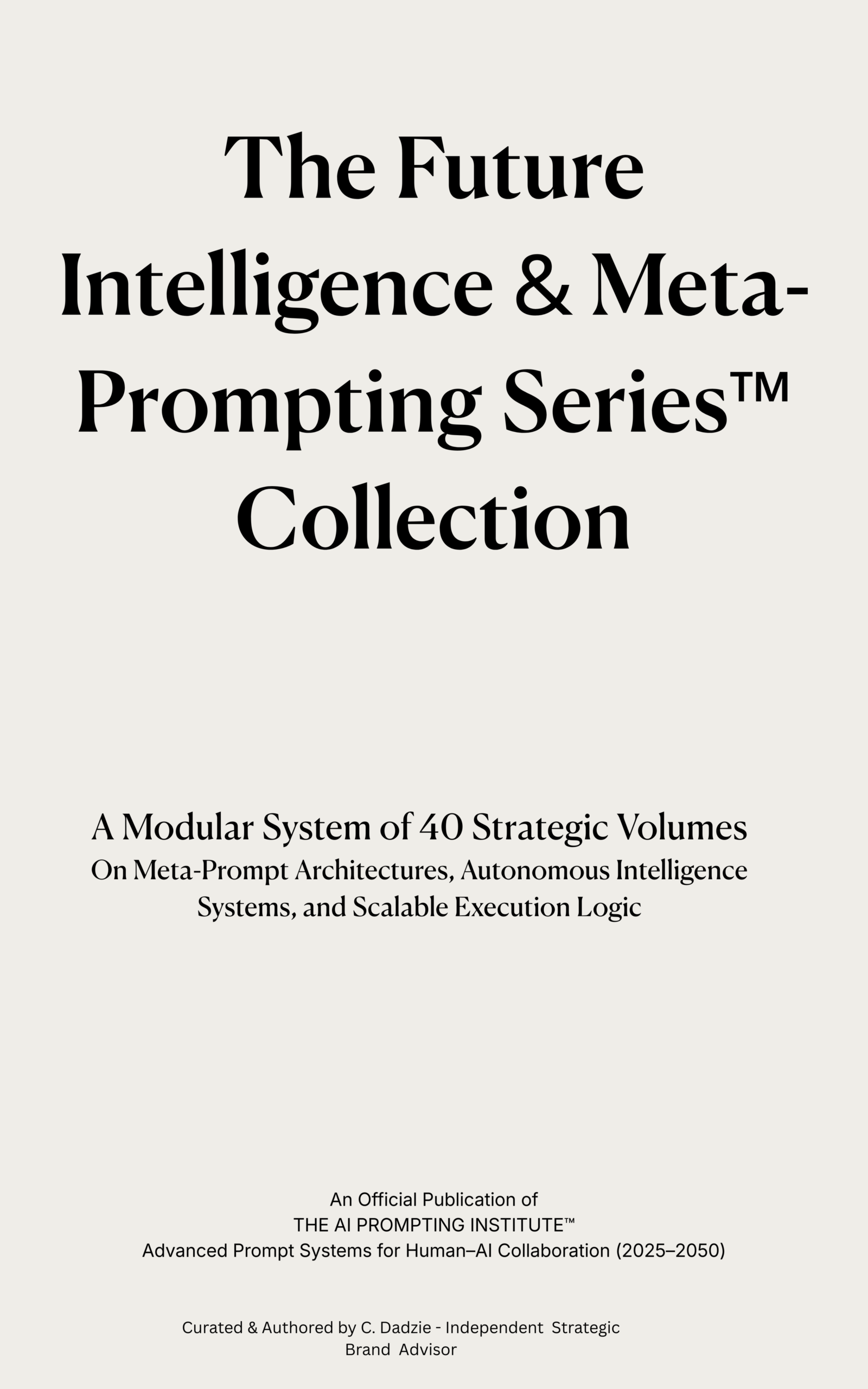
€ 6500
Prompting is not the future of intelligence.
It is the transition layer.
This collection explores what comes after prompts:
meta-prompting, system-level intelligence, human-AI co-thinking, and the architectures that will define how intelligence itself is designed, governed, and evolved.
Without this collection, you learn to use AI.
With it, you learn to shape intelligence.
What you lose without this collection:
You remain a user in a world that will be designed by architects.
“Applied by 120+ strategists”
“Used in 7 markets”
“Tested across 4 industries”
This collection operates within the Foundational Axiom established by the Institute.
Meta-intelligence emerges when systems observe their own reasoning.
A structured methodology to align leadership,
redesign decision architecture and accelerate execution.
Siemens successfully evolved from a traditional
engineering company into a leader in industrial automation.
This transformation required:
• strategic portfolio redesign
• digital infrastructure investments
• organizational restructuring
Large organizations must periodically redesign
their strategic architecture to remain competitive.
1. Strategic Deconstruction
Identifying structural barriers to execution.
2. Decision Architecture
Redesigning how strategic decisions are made.
3. Organizational Alignment
Aligning leadership structures and incentives.
4. Strategic Adaptability
Building systems capable of responding to change.
• leadership misalignment
• slow decision cycles
• organizational complexity
• strategy disconnected from execution
It fails because organizations cannot execute them.
This system is built on years of research into
organizational strategy, leadership alignment and
decision architecture inside complex organizations.
Phase 1 — Strategic Diagnostic
Analyzing organizational execution barriers.
Phase 2 — Leadership Alignment
Aligning leadership teams around strategic priorities.
Phase 3 — Decision Architecture
Redesigning how strategic decisions are made.
Phase 4 — Execution Acceleration
Implementing new strategic operating principles.
Industry: Technology / AI SaaS
Region: Global (US / Europe)
Annual Revenue: €18M
Teams: Product, Growth, Operations, Strategy
Despite advanced AI adoption, the company faced:
A deep audit revealed:
Deployment of the
Future Intelligence & Meta-Prompting Systems™
AI usage was not the constraint.
👉 The constraint was lack of intelligence architecture
By transforming AI into a meta-intelligence system:
👉 The company built a self-improving intelligence layer
From:
To:
Most organizations:
Few:
👉 design meta-prompt architectures
The future is not:
It is:
👉 systems that think, adapt, and scale intelligence
⭐⭐⭐⭐⭐
Challenge
Our AI team was using prompts effectively, but we lacked a deeper framework to design prompt systems that could scale across complex workflows.
What we implemented
After studying the meta-prompting frameworks in this collection, we redesigned how prompts interact with each other inside our AI workflows.
Result
The new structure allowed us to build layered prompt systems capable of producing more consistent and sophisticated outputs across multiple tasks.
Dr. Amir K. — AI Research Fellow — Dubai
Frameworks applied
• Meta-Prompt Architecture Framework
• Cognitive Prompt System
• Advanced AI Interaction Model
Application context
• AI research team
• Advanced LLM workflows
• Middle East technology sector
⭐⭐⭐⭐⭐
Challenge
Our innovation team was experimenting with advanced AI use cases but lacked a structured framework for designing intelligent prompt systems.
What we implemented
Using the meta-prompting models in this collection, we designed a multi-layer prompting architecture capable of guiding complex reasoning processes.
Result
This approach significantly improved the quality of AI-assisted analysis and allowed our team to build much more sophisticated AI workflows.
Kevin T. — AI Product Manager — Seattle
Frameworks applied
• Meta-Prompt Design Model
• Intelligent Prompt Chaining Framework
• Advanced AI Reasoning System
Application context
• AI product development
• Technology company
• North American market
⭐⭐⭐⭐⭐
Challenge
Our organization wanted to push AI usage beyond simple prompts and explore how structured prompting systems can enhance decision-making.
What we implemented
The frameworks in this collection helped us design advanced prompting architectures capable of guiding strategic analysis and knowledge synthesis.
Result
The change allowed our team to unlock much more powerful insights from AI systems while maintaining consistency and reliability in outputs.
Daniel C. — Innovation Strategy Manager — Toronto
Frameworks applied
• Meta-Prompt Strategy Framework
• Knowledge Synthesis Model
• Advanced AI Thinking System
Application context
• Corporate innovation department
• Strategy and research teams
• North American market
The Future of Prompting — What Will Replace Prompts in 2050.
Prompting Beyond Text — Gestures, Thoughts, Signals.
The Future Human Interface — Communicating Beyond Words.
The Universal Prompt Format — A Language for All AI.
⚡ Outcome:
A new communication layer for post-text, next-generation AI interaction
Prompting for Superintelligence — Communicating With Future AI.
Infinite Intelligence Prompting — The Next Stage of AI.
Prompting for Universal Intelligence — Designing Higher Thought.
The Meta-Prompt Codex — The Highest Level of Prompting.
The Prompt God Mode — Unlocking Maximum AI Power.
⚡ Outcome:
A high-level prompting architecture for extreme intelligence systems
The Human-Machine Merge — Co-Thinking With AI.
AI & Human Intelligence Fusion — Co-Creation at Scale.
Cognitive Evolution Prompting — Upgrading Human Minds.
Synthetic Thought Prompting — Creating New Cognitive Processes.
Post-Human Prompting — Designing a New Level of Thought.
⚡ Outcome:
A new framework for human-AI co-intelligence and cognitive augmentation
AI Consciousness Prompting — Exploring the Edges of Intelligence.
Philosophical Prompting — Meaning, Logic & Meta-Thinking.
Spiritual Prompting — Consciousness, Mind & AI.
Transcendent Prompting — The Spiritual Dimension of AI.
The AI Philosopher — Prompts That Challenge Reality.
⚡ Outcome:
A meta-intelligence layer for consciousness, meaning, and higher-order inquiry
The Ethical Prompt Engineer — Morality, Safety & Power.
Ethical Safety Nets — Prompts That Protect Humanity.
Prompting for Peace — Solving Global Problems With AI.
⚡ Outcome:
A protective ethics layer for powerful intelligence systems
Prompting the Future Economy — AI for Global Decisions.
Society-Scale Prompting — AI for Nations & Civilizations.
Global System Prompting — Large-Scale Decision Prompts.
Prompting for Future Civilizations — AI Beyond Earth.
⚡ Outcome:
A macro-scale prompting framework for economies, societies, and civilization design
Prompting for Multi-Species Communication — AI as Translator.
Quantum Prompting — Instructions for Quantum AI.
Interplanetary Prompting — AI for Space & Colonization.
⚡ Outcome:
A frontier architecture for non-standard, non-earthbound intelligence systems
AI Reality Design — Shaping Perception With Prompts.
AI-Driven Reality Shaping — Influence, Power & Perception.
Prompting the Unknown — Exploring Territories Beyond Logic.
Prompting for Complexity — Mastering Chaotic Systems.
⚡ Outcome:
A strategic system for perception control, reality modeling, and complexity navigation
Prompting for Immortality — Longevity, Health & AI.
⚡ Outcome:
A specialized intelligence layer for radical human enhancement thinking
The Future Prompt Architect — Designing Intelligence.●
●
●
The Infinite Prompt — Instructions That Evolve Themselves.
The Ultimate System Prompt — Control the AI Completely.
The Eternal Prompt Library — Prompts That Never Expire.
⚡ Outcome:
A master architecture for self-improving, long-life prompt systems
Prompting for World-Class Thinkers — Genius-Level Reasoning.
⚡ Outcome:
A precision layer for elite reasoning and cognitive excellence
Prompting the Impossible — Achieving Unimaginable Outcomes.
⚡ Outcome:
A breakthrough layer for limit-breaking prompt execution
Access to this system is intentionally limited to a small number of organizations each year.
Strategic Investment: $6,500
• One-time payment
• Lifetime system license
• Immediate access upon purchase
• Full framework and methodology access
• All future updates included
• Designed for executives and organizations
Level: Strategic Advisory
Format: Digital Access
🔒Secure payment processing. All transactions are encrypted and protected.
Instant access is provided immediately after purchase.
THE FUTURE INTELLIGENCE & META-PROMPTING™
is not about writing prompts.
It is a strategic framework for designing the next generation of human-AI intelligence systems.
The Strategic Framework for Designing Next-Generation Human-AI Intelligence Systems
Price: $6,500
Format: Strategic Intelligence Framework
The real transformation comes when organizations move beyond prompts and begin designing intelligence systems.
The next frontier is meta-prompting.
A layer where AI systems generate prompts, reasoning chains, and agent instructions automatically.
In this new paradigm:
Human intelligence defines direction.
AI systems generate structured insight.
Organizations stop using AI tools.
They begin building AI cognition infrastructures.
This is the premise behind:
THE FUTURE INTELLIGENCE & META-PROMPTING™
A strategic framework for executives, strategists, and innovation leaders who want to design the next generation of human-AI intelligence systems.
The Future of Human-AI Intelligence
Artificial intelligence is evolving through three stages.
Individuals interact with AI through direct prompts.
Productivity increases.
But intelligence remains fragmented.
Organizations start structuring prompt frameworks.
Processes become repeatable.
AI begins supporting workflows.
AI systems generate prompts, coordinate agents, and structure reasoning.
Instead of isolated tools, organizations deploy intelligence architectures.
Decision-making accelerates.
Knowledge becomes dynamic.
Insight becomes automated.
This is the transition from AI tools to AI intelligence infrastructures.
Why Basic Prompting Is Already Obsolete
Most companies currently use AI in a limited way.
They experiment with prompts.
They test tools.
They automate small tasks.
But this approach creates several problems.
• inconsistent outputs
• fragmented workflows
• cognitive overload
• lack of strategic integration
AI remains a productivity assistant, not a strategic capability.
Meanwhile, the complexity of modern organizations is increasing dramatically.
• massive data streams
• rapid innovation cycles
• global market volatility
• accelerating technological change
Human reasoning alone cannot synthesize this level of complexity fast enough.
Organizations need a new layer.
An AI intelligence layer capable of generating structured insight continuously.
This is where meta-prompting architectures emerge.
Most people prompt AI directly.
Future systems will use meta-prompting.
Meta-prompting means:
AI generates the prompts that guide other AI systems.
Instead of individuals writing prompts manually, organizations deploy structured intelligence architectures.
These architectures coordinate multiple AI agents performing different reasoning tasks.
• intelligence synthesis
• market analysis
• innovation hypothesis generation
• strategic scenario simulation
Meta-prompts orchestrate these agents and generate structured reasoning chains.
The result is a multi-layer intelligence system.
When prompt architecture improves, system intelligence grows.
Before designing AI systems, organizations must understand where their decision systems break down.
Typical problems include:
• information overload
• slow research cycles
• fragmented knowledge
• delayed insight generation
Intelligence diagnosis identifies the structural bottlenecks preventing organizations from transforming data into strategic insight.
Instead of isolated prompts, organizations build prompt frameworks.
These frameworks structure reasoning processes and guide AI agents through complex analytical tasks.
Prompt systems transform AI from a conversational interface into a structured intelligence engine.
Meta-prompting coordinates multiple AI agents.
Each agent performs a specialized reasoning function.
Examples include:
• market intelligence agents
• technology trend agents
• strategic hypothesis agents
• innovation exploration agents
Through orchestration, these agents collaborate to generate deeper insight.
Advanced systems continuously improve themselves.
AI systems analyze their previous outputs and refine their own prompts.
This creates adaptive intelligence loops.
Over time, the intelligence architecture becomes more sophisticated and more accurate.
AI systems generate structured intelligence.
Humans define strategy.
This partnership creates augmented cognition.
Organizations combine human strategic vision with machine reasoning capacity.
These demonstrations illustrate how meta-prompting architectures could transform decision systems in major global organizations.
They are strategic explorations of future intelligence systems.
Modern technology companies operate in environments characterized by:
• massive data streams
• rapid innovation cycles
• complex decision environments
Human teams alone struggle to synthesize this level of complexity.
A meta-prompting architecture could introduce structured intelligence agents.
For example:
Intelligence Generation Agents
Market Analysis Agents
Innovation Hypothesis Agents
Strategic Scenario Agents
These agents continuously generate structured insights for leadership.
Executives receive synthesized intelligence rather than fragmented information.
The result:
• faster strategic analysis
• automated insight generation
• reduced cognitive overload
AI becomes an organizational reasoning infrastructure.
Electric vehicle markets evolve rapidly.
Companies must constantly anticipate:
• regulatory shifts
• technology breakthroughs
• competitor innovation
• consumer adoption patterns
A Strategic Scenario Engine™ could simulate potential market futures continuously.
Meta-prompting systems would generate and analyze thousands of possible scenarios.
Executives would receive scenario intelligence, not raw data.
Decision-making becomes proactive rather than reactive.
Large global organizations face knowledge fragmentation.
Information exists across multiple departments, teams, and systems.
The result is slow synthesis and delayed strategic insight.
A meta-prompting knowledge architecture could deploy agents that:
• interpret internal knowledge
• summarize strategic information
• generate hypotheses
• coordinate decision intelligence
The organization evolves into an intelligence-driven system.
Most organizations interact with AI like this:
• individual prompts
• isolated experiments
• inconsistent results
AI functions primarily as a productivity tool.
The strategic potential remains underdeveloped.
Organizations deploy structured intelligence infrastructures.
AI agents collaborate continuously.
Insights are generated automatically.
Decision velocity increases dramatically.
AI becomes a cognitive layer for the organization.
Meta-prompting systems accelerate insight generation.
When organizations increase the speed of strategic intelligence, competitive advantage compounds.
For example:
If a company can:
• reduce research cycles by 40%
• accelerate innovation analysis
• generate faster strategic insight
the economic impact becomes substantial.
Even small improvements in decision velocity can translate into millions in operational value.
The leverage effect of intelligence systems is exponential.
Compared to the scale of organizational decision-making, the investment in strategic architecture is minimal.
Strategic Intelligence Framework
Investment: $6,500
This framework provides a structured methodology for designing next-generation human-AI intelligence systems.
The framework includes:
• the Meta-Prompting Intelligence Architecture™
• the five pillars of intelligence system design
• agent orchestration models
• recursive intelligence frameworks
• human-AI governance structures
It is designed for:
• executives
• strategists
• innovation leaders
• AI transformation consultants
Professionals who want to move beyond prompting and begin designing AI intelligence infrastructures.
🔒Secure payment processing. All transactions are encrypted and protected.
Instant access is provided immediately after purchase.
Lorem ipsum dolor sit amet, consectetur adipiscing elit. Ut elit tellus, luctus nec ullamcorper mattis, pulvinar dapibus leo.
When large organizations want to redesign how they generate strategic intelligence, they typically turn to consulting firms.
The process usually looks like this.
First, a consulting firm is hired to conduct a strategic assessment.
Teams interview executives.
They analyze internal processes.
They evaluate information flows and decision cycles.
This phase alone can take six to eight weeks.
Consultants map how information moves across the organization.
They identify bottlenecks in:
• research processes
• knowledge synthesis
• strategic decision cycles
• innovation analysis
This diagnostic phase alone often costs $75,000 to $150,000.
Next, consulting teams design new strategic processes.
They propose frameworks for:
• decision intelligence
• knowledge management
• strategic analysis workflows
• innovation evaluation systems
This phase typically costs $150,000 to $300,000.
Finally, organizations implement the new frameworks.
Teams adopt new processes.
Leadership integrates new decision structures.
Technology systems are adapted.
The full transformation process can exceed $500,000.
And often takes 6 to 12 months.
THE FUTURE INTELLIGENCE & META-PROMPTING™ framework provides the intellectual architecture behind modern intelligence systems.
Instead of purchasing months of consulting work, you gain direct access to the strategic methodology.
The framework includes the core components used to design intelligence infrastructures:
• intelligence diagnosis models
• prompt system architecture
• agent orchestration frameworks
• recursive intelligence systems
• human-AI governance structures
Rather than hiring consultants to explain these systems, you gain the strategic blueprint directly.
Consulting firms typically sell analysis and time.
This framework delivers architecture and methodology.
It allows leaders, strategists, and consultants to begin designing intelligence systems immediately.
Without waiting months.
Without six-figure consulting budgets.
Without organizational delays.
The investment for this strategic framework is $6,500.
Compared to traditional consulting engagements, the difference is obvious.
You are acquiring the intellectual architecture of next-generation intelligence systems.
Not months of consulting overhead.
In complex organizations, even small improvements in decision intelligence can produce extraordinary economic value.
When insight generation accelerates,
innovation accelerates.
When innovation accelerates,
competitive advantage compounds.
A strategic framework for designing the next generation of human-AI intelligence systems.
🔒Secure payment processing. All transactions are encrypted and protected.
Instant access is provided immediately after purchase.
We use cookies and similar technologies to ensure the proper functioning of this website, to analyze traffic, and to improve your experience.
You can accept all cookies, reject non-essential cookies, or customize your preferences at any time.