
|
🚧 Marketingadss is currently being redesigned to better serve you. Online services and purchases will be available soon.
|
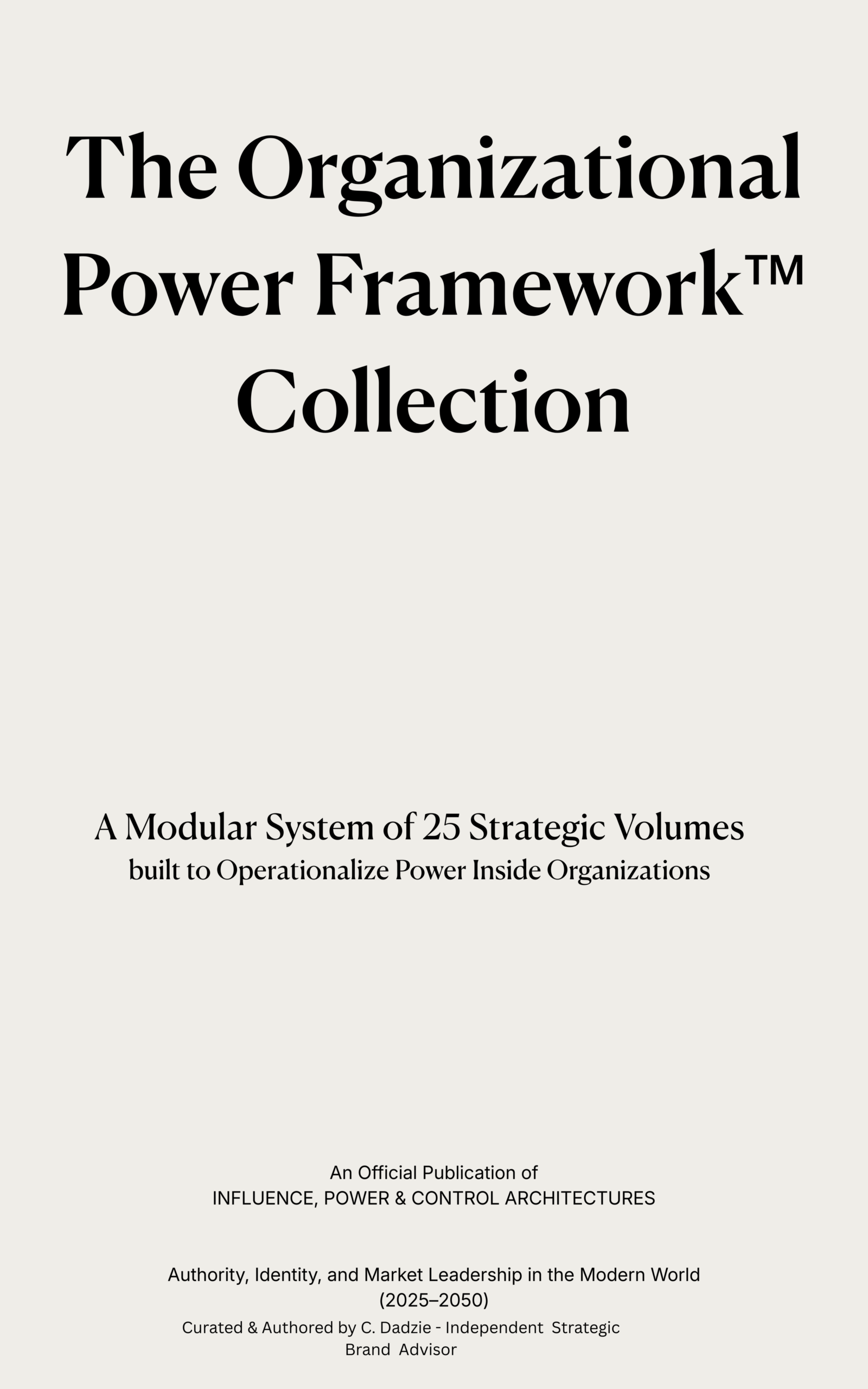
€ 4500
Organizations do not fail because of people.
They fail because of power architecture.
This collection reveals how power actually circulates inside organizations — and why most structures silently destroy authority, speed, and strategic clarity.
Without this framework, you manage behavior.
With it, you control structure.
What you lose without this collection:
You remain inside the organization — never above it.
“Applied by 120+ strategists”
“Used in 7 markets”
“Tested across 4 industries”
This collection operates within the Foundational Axiom established by the Institute.
Organizations fail when structure contradicts intent.
A structured methodology to align leadership,
redesign decision architecture and accelerate execution.
Siemens successfully evolved from a traditional
engineering company into a leader in industrial automation.
This transformation required:
• strategic portfolio redesign
• digital infrastructure investments
• organizational restructuring
Large organizations must periodically redesign
their strategic architecture to remain competitive.
1. Strategic Deconstruction
Identifying structural barriers to execution.
2. Decision Architecture
Redesigning how strategic decisions are made.
3. Organizational Alignment
Aligning leadership structures and incentives.
4. Strategic Adaptability
Building systems capable of responding to change.
• leadership misalignment
• slow decision cycles
• organizational complexity
• strategy disconnected from execution
It fails because organizations cannot execute them.
This system is built on years of research into
organizational strategy, leadership alignment and
decision architecture inside complex organizations.
Phase 1 — Strategic Diagnostic
Analyzing organizational execution barriers.
Phase 2 — Leadership Alignment
Aligning leadership teams around strategic priorities.
Phase 3 — Decision Architecture
Redesigning how strategic decisions are made.
Phase 4 — Execution Acceleration
Implementing new strategic operating principles.
Company Type: Mid-size enterprise
Industry: Technology / Services
Region: Europe
Employees: ~280
Revenue: €35M annual
Despite strong strategy and leadership talent, the organization faced:
👉 Problem: strategy existed — execution failed
The issue was not:
❌ strategy
❌ talent
❌ resources
👉 It was unstructured power distribution
Deployment of
Organizational Power Framework™
👉 Objective: see how power actually flows
👉 Objective: align power with strategy
👉 Objective: remove friction from execution
👉 Objective: make execution inevitable
The company did not need better strategy.
👉 It needed control over internal power dynamics
The transformation led to:
From:
To:
👉 engineering power flows inside the organization
Most organizations:
Few:
👉 design how power operates inside the system
Execution improved not by:
But by:
👉 restructuring who has the power to decide and act
⭐⭐⭐⭐⭐
Challenge
Our organization was growing, but decision-making was becoming slower and more complex as more teams and departments became involved.
What we implemented
After studying the organizational power frameworks in this collection, we redesigned how authority and decision flows operate inside the company.
Result
The change significantly improved clarity around responsibilities and allowed leadership to make faster and more strategic decisions.
Dr. Robert L. — Organizational Strategy Advisor — Chicago
Frameworks applied
• Organizational Power Mapping
• Decision Authority Framework
• Structural Influence Model
Application context
• Corporate leadership team
• Mid-size organization
• North American market
⭐⭐⭐⭐⭐
Challenge
Our company had talented teams but internal coordination between departments was inconsistent and slowed down execution.
What we implemented
The organizational structure frameworks from this collection helped us redesign how departments collaborate and how strategic initiatives move through the organization.
Result
Execution became much smoother and several internal bottlenecks that previously slowed projects were eliminated.
Daniel C. — Operations Director — Toronto
Frameworks applied
• Organizational Alignment Model
• Strategic Execution Framework
• Cross-Team Coordination System
Application context
• Technology company
• Operations department
• North American market
⭐⭐⭐⭐⭐
Challenge
Our consulting clients often struggled with internal power dynamics that affected strategic decision-making.
What we implemented
Using the frameworks from this collection, we introduced a structured diagnostic model to analyze influence and decision structures inside organizations.
Result
This allowed our clients to understand where real influence sits within the organization and redesign their governance structure accordingly.
Laura M. — Management Consultant — London
Frameworks applied
• Organizational Influence Analysis
• Governance Structure Framework
• Strategic Authority Model
Application context
• Consulting firm
• Corporate clients
• European market
1. The Corporate Social Framework
2. AI-Driven Enterprise Branding
3. The Future-Ready Organization
4. Corporate Visibility Mastery
👉 Focus:
Brand identity at scale
Market positioning
Long-term relevance
3. Enterprise Social Governance Systems
4. The Multi-Brand Social Playbook
5. Social Operations 2050
6. Enterprise Influence Map
👉 Focus:
Internal structure
Multi-team coordination
Scalable communication systems
4. The CEO’s Digital Influence Playbook
5. The Enterprise Influence System
6. The Enterprise Attention Strategy
7. Corporate Storytelling Mastery
👉 Focus:
Executive presence
Leadership influence
Narrative control
5. The Corporate Content Engine
6. The Enterprise AI Content Director
7. The AI-Powered Marketing Department
👉 Focus:
Content production at scale
Automation + creativity
Brand consistency
8. Social Media Transformation
9. The Corporate Growth Accelerator
10. The Global Brand Ecosystem
👉 Focus:
Market expansion
Multi-platform dominance
Growth acceleration
7. The Enterprise Trust Blueprint
8. Brand Reputation Engineering Architect
9. Intelligent Crisis Communication
👉 Focus:
Trust building
Reputation control
Risk management
9. AI-Enhanced Customer Experience
10. The Organizational Engagement Engine
👉 Focus:
Customer experience
Engagement systems
Retention
14. The Social Selling Enterprise
15. The Employee Influence Network
👉 Focus:
Internal influence
Employee advocacy
Culture amplification
11. The Corporate Growth Accelerator (shared module)
12. AI-Enhanced Customer Experience (shared impact)
👉 Focus:
Revenue generation
Lead acquisition
Market expansion
6. The Future-Ready Organization (shared)
7. Social Operations 2050 (shared)
8. AI-Driven Enterprise Branding (shared)
👉 Focus:
AI integration
future-proof systems
long-term scalability
Access to this system is intentionally limited to a small number of organizations each year.
Strategic Investment: $4,500
• One-time payment
• Lifetime system license
• Immediate access upon purchase
• Full framework and methodology access
• All future updates included
• Designed for executives and organizations
Level: Strategic Advisory
Format: Digital Access
🔒Secure payment processing. All transactions are encrypted and protected.
Instant access is provided immediately after purchase.
THE ORGANISATIONAL POWER FRAMEWORK COLLECTION™
is not a management course.
It is a strategic framework for understanding how organizations design systems of power, operational excellence, and long-term competitive advantage.
Strategic Systems for Building High-Power Organizations
Price: $4,500
Theme: Influence • Organizational Power • Strategic Control
The most dominant organizations in the world do not win because of marketing brilliance or charismatic leadership.
They win because they are structurally engineered for power.
Behind every high-performing organization lies an invisible architecture:
• decision systems
• operational flows
• execution discipline
• scalable infrastructure
These structures determine whether a company moves slowly and reactively, or rapidly and decisively.
Most companies attempt to improve performance by:
• increasing marketing budgets
• hiring more people
• launching new initiatives
But these efforts rarely produce lasting results.
Why?
Because organizational structure determines performance.
When a company’s internal systems are misaligned, even the best strategy fails.
When the organizational architecture is powerful, execution becomes natural, scalable, and efficient.
The Organisational Power Framework Collection™ was designed to help leaders understand how the most effective organizations in the world engineer structural power.
Many organizations reach a stage where growth becomes increasingly difficult.
Revenue may increase, but internal complexity begins to create friction.
Symptoms typically appear in the form of:
• fragmented processes
• slow decision cycles
• unclear leadership authority
• operational inefficiencies
• coordination breakdowns between teams
At first, these problems appear operational.
But the root cause is deeper.
Most organizations were not deliberately designed.
They evolved organically.
Departments were created when needed.
Processes were added as problems appeared.
Leadership structures developed informally.
Over time, this creates structural incoherence.
Instead of operating as a coordinated system, the organization becomes a collection of disconnected parts.
The result:
• slower execution
• increasing costs
• declining strategic agility
Companies then attempt to fix these issues through superficial changes.
More meetings.
More reporting.
More layers of management.
But complexity rarely solves structural problems.
What organizations actually need is architectural clarity.
They need a framework for designing systems that produce operational power.
Organizational dominance does not emerge by accident.
It follows a structural principle.
When the following forces align, organizations achieve extraordinary efficiency and influence.
This framework identifies the core components of organizational power.
Most organizational problems originate from structural misalignment.
Strategy may be sound, but the organization is not designed to execute it.
Strategic diagnosis identifies:
• structural inefficiencies
• misaligned incentives
• operational bottlenecks
• decision delays
Before redesigning an organization, leaders must first understand how the current system actually functions.
Diagnosis reveals the hidden mechanisms limiting performance.
Powerful organizations are not accidental.
They are deliberately engineered.
Organizational design determines:
• decision hierarchies
• authority distribution
• communication flows
• operational processes
The structure of an organization determines the speed and quality of execution.
When design is weak, performance becomes unpredictable.
When design is intentional, the organization becomes a coordinated system of action.
Ideas alone never create results.
Execution systems do.
High-power organizations establish mechanisms that ensure:
• operational discipline
• accountability
• consistency of performance
Execution systems include:
• performance tracking
• operational routines
• leadership coordination structures
When execution systems are strong, results become repeatable and scalable.
Organizations that dominate their industries possess systems designed for scale.
This includes:
• production capabilities
• technological infrastructure
• supply chain coordination
• distribution systems
Infrastructure allows organizations to expand without losing operational control.
Scale amplifies influence.
Without infrastructure, growth creates chaos.
Markets evolve.
Technologies change.
Competitors emerge.
Powerful organizations design systems that allow continuous adaptation.
This includes the ability to respond to:
• market shifts
• technological disruption
• global competition
Adaptability ensures that organizational power is sustained over time.
Instead of relying on testimonials, this framework demonstrates strategic thinking through the analysis of dominant organizations.
These companies did not achieve global influence through advertising alone.
They built operational systems that created structural advantage.
Current Situation
Zara built dominance through:
• vertically integrated production
• rapid product cycles
• real-time consumer feedback loops
The company can design, produce, and distribute new fashion products in weeks.
Strategic Insight
Zara’s competitive power is not marketing.
It is organizational speed.
By integrating production and retail feedback loops, the company built an operational machine capable of responding instantly to demand.
Speed becomes a strategic weapon.
Observation
H&M expanded globally through:
• extensive supplier networks
• centralized design coordination
• large-scale retail distribution
The company developed a structure capable of coordinating thousands of suppliers and stores.
Strategic Lesson
Organizational power often emerges when systems are designed for scale and coordination.
H&M demonstrates how large operational networks can be managed effectively through centralized strategic control.
Diagnostic
Uniqlo achieved authority through:
• product simplicity
• operational efficiency
• manufacturing precision
Rather than pursuing rapid fashion cycles, the company focuses on disciplined operational systems.
Strategic Insight
Organizational power does not always come from complexity.
Uniqlo demonstrates that disciplined processes and operational mastery can outperform chaotic innovation.
These examples reveal a consistent pattern:
Powerful organizations design systems of execution.
Many companies operate with structures that evolved informally.
This creates:
• fragmented processes
• unclear leadership authority
• operational inefficiency
• slow strategic execution
Growth becomes difficult because the organization itself limits performance.
Organizations begin to operate differently.
They develop:
• efficient operational systems
• clear decision hierarchies
• scalable organizational structures
• strong execution discipline
Instead of resisting growth, the organization becomes a competitive advantage.
Execution accelerates.
Coordination improves.
Strategic initiatives move faster.
Organizational efficiency has a direct impact on financial performance.
Small improvements in operational systems can produce significant economic results.
Example scenario:
Company revenue: $10M
If organizational efficiency improves by 15%, the company may generate approximately:
$1.5M in additional value annually.
This value comes from:
• faster execution
• lower operational friction
• improved coordination
• better strategic alignment
The leverage is clear.
Framework investment: $4,500
Potential organizational impact: multiples of that investment.
The true value of organizational architecture lies in the compounding effects of better systems.
This framework provides a structured approach to understanding how powerful organizations are built.
Inside the collection you will explore:
• The Organisational Power Architecture™
• The 5 Pillars of Organisational Power™
• Strategic analyses of dominant companies
• Organizational system diagrams
• execution frameworks used by high-performance organizations
This is not theoretical management advice.
It is a strategic lens for understanding how organizations create structural advantage.
$4,500
For leaders, consultants, and strategists who want to understand the hidden architecture behind dominant organizations.
Because power in business rarely comes from ideas alone.
It comes from systems.
🔒Secure payment processing. All transactions are encrypted and protected.
Instant access is provided immediately after purchase.
Lorem ipsum dolor sit amet, consectetur adipiscing elit. Ut elit tellus, luctus nec ullamcorper mattis, pulvinar dapibus leo.
Most business programs are priced for information consumption.
This framework is priced for strategic leverage.
There is a fundamental difference.
Information is cheap.
Strategic clarity is not.
The Organisational Power Framework Collection™ is not designed to add more ideas to your library.
It is designed to help you see how powerful organizations actually work.
And once you see the structure behind organizational power, you cannot unsee it.
That perspective compounds across every decision you make as a leader.
Most companies underestimate the cost of structural inefficiency.
The problem is not always visible.
It hides inside:
• slow decision cycles
• operational bottlenecks
• unclear authority structures
• fragmented execution systems
These invisible frictions quietly destroy millions in potential value.
A company generating €10M in revenue does not need dramatic transformation to create impact.
A 10–15% improvement in organizational efficiency may represent:
€1M – €1.5M of additional annual value.
Compared to that leverage, the price of strategic clarity becomes negligible.
Operational advice focuses on:
• tactics
• productivity hacks
• short-term improvements
Strategic frameworks operate at a different level.
They help leaders understand:
• how organizations are structured
• how power flows through systems
• how operational discipline is built
• how scale becomes possible
This knowledge is rarely accessible outside:
• elite consulting firms
• executive leadership programs
• decades of leadership experience
The Organisational Power Framework Collection™ distills these structural insights into a clear strategic model.
Executives do not invest in frameworks because they lack information.
They invest because better mental models create better decisions.
The ability to diagnose organizational structures, execution systems, and operational power dynamics changes how leaders approach:
• scaling
• restructuring
• operational strategy
• long-term growth
The value of that perspective compounds across years of decisions.
Strategic consulting engagements often require:
• €25,000
• €50,000
• €100,000+
For organizational diagnostic work and structural recommendations.
The Organisational Power Framework Collection™ provides a strategic architecture inspired by the same structural thinking.
Without the six-figure consulting engagement.
This framework is designed for individuals who operate at a strategic level:
• founders scaling organizations
• consultants advising companies
• executives responsible for operational performance
• strategists studying organizational power
It is not designed for casual business learning.
It is designed for people who want to understand how powerful organizations are built.
THE ORGANISATIONAL POWER FRAMEWORK COLLECTION™
Strategic Systems for Building High-Power Organizations
Executive Investment: €4,500
This price reflects the level of thinking behind the framework.
Because when you understand the architecture behind organizational power, you gain something far more valuable than information:
You gain strategic clarity.
And strategic clarity changes how organizations are built.
🔒Secure payment processing. All transactions are encrypted and protected.
Instant access is provided immediately after purchase.
We use cookies and similar technologies to ensure the proper functioning of this website, to analyze traffic, and to improve your experience.
You can accept all cookies, reject non-essential cookies, or customize your preferences at any time.