
|
🚧 Marketingadss is currently being redesigned to better serve you. Online services and purchases will be available soon.
|
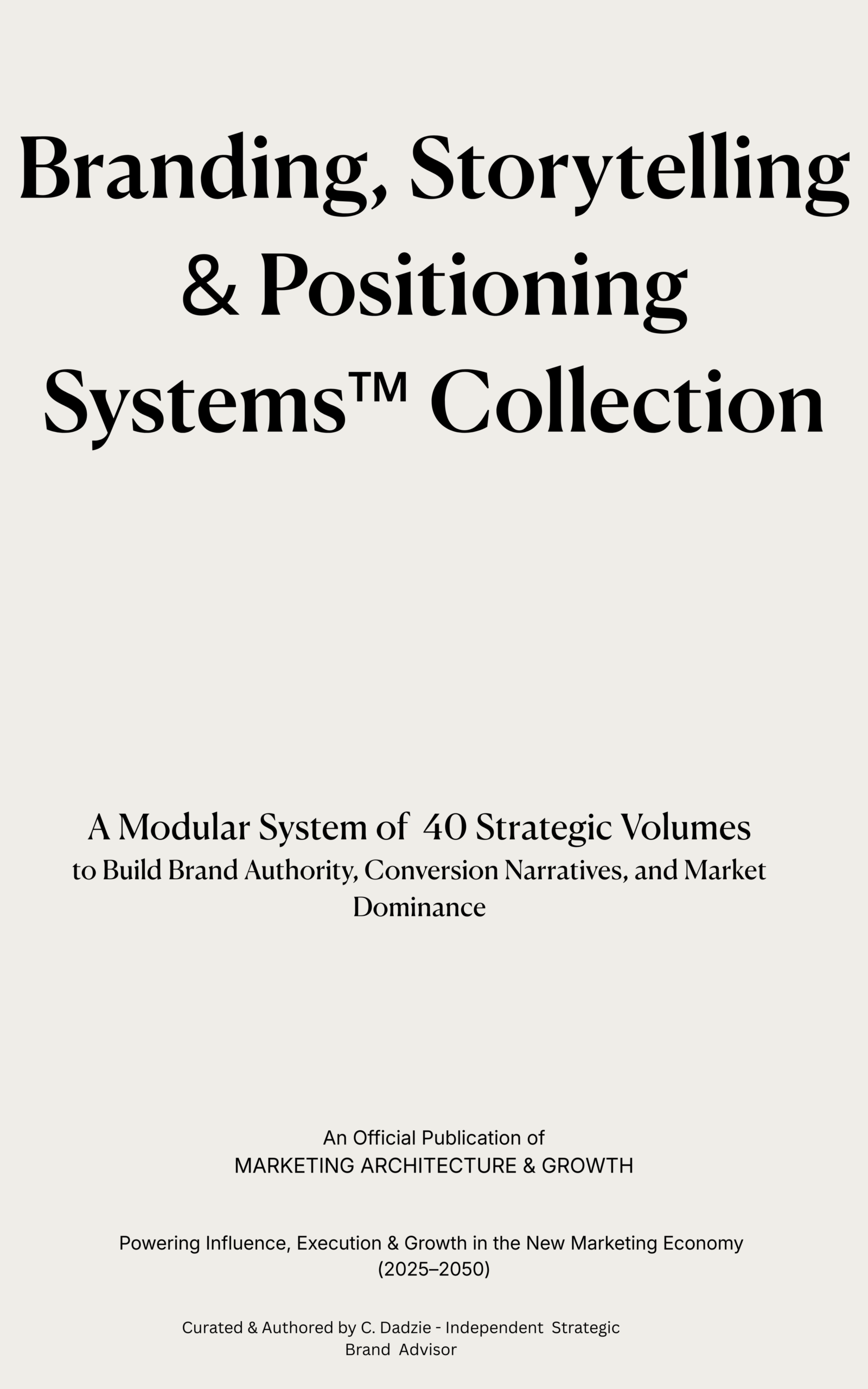
€ 2900
Branding is not design.
Storytelling is not narration.
Positioning is not differentiation.
They are systems that decide who is believed, remembered, and chosen.
The Branding, Storytelling & Positioning Systems collection gives you practical control over how meaning, authority, and preference are constructed in the minds of others.
Without this collection, you communicate.
With it, you structure perception.
What you lose without it:
You remain visible — but replaceable.
“Applied by 120+ strategists”
“Used in 7 markets”
“Tested across 4 industries”
A structured methodology to align leadership,
redesign decision architecture and accelerate execution.
Siemens successfully evolved from a traditional
engineering company into a leader in industrial automation.
This transformation required:
• strategic portfolio redesign
• digital infrastructure investments
• organizational restructuring
Large organizations must periodically redesign
their strategic architecture to remain competitive.
1. Strategic Deconstruction
Identifying structural barriers to execution.
2. Decision Architecture
Redesigning how strategic decisions are made.
3. Organizational Alignment
Aligning leadership structures and incentives.
4. Strategic Adaptability
Building systems capable of responding to change.
• leadership misalignment
• slow decision cycles
• organizational complexity
• strategy disconnected from execution
It fails because organizations cannot execute them.
This system is built on years of research into
organizational strategy, leadership alignment and
decision architecture inside complex organizations.
Phase 1 — Strategic Diagnostic
Analyzing organizational execution barriers.
Phase 2 — Leadership Alignment
Aligning leadership teams around strategic priorities.
Phase 3 — Decision Architecture
Redesigning how strategic decisions are made.
Phase 4 — Execution Acceleration
Implementing new strategic operating principles.
Company Type: Premium service company
Industry: Consulting / Creative Strategy
Region: Europe
Revenue: €1.8M annually
Positioning: Mid-market, competitive
The company was:
👉 Problem:
value existed — but perception did not reflect it
The company was competing on:
❌ services
❌ capabilities
Instead of:
👉 narrative + authority positioning
Deployment of
Branding, Storytelling & Positioning Systems™
👉 Objective: escape competition
👉 Objective: control perception
👉 Objective: build perceived expertise
👉 Objective: translate perception into revenue
The transformation did not come from:
But from:
👉 changing how the offer was perceived
The company shifted from:
To:
👉 being selected as the obvious choice
From:
To:
👉 category authority
Markets do not reward:
They reward:
👉 the most convincingly positioned solution
Growth came not from:
But from:
👉 owning a narrative that shaped buyer perception
⭐⭐⭐⭐⭐
Challenge
Our company had a good product but our brand positioning was unclear. Customers understood what we offered, but not why we were different from competitors.
What we implemented
We applied the brand positioning and narrative architecture frameworks from this collection to redesign our brand messaging.
Result
The new positioning clarified our value proposition and helped us communicate our brand in a much more powerful way. It significantly improved how customers perceive our brand.
Sophie D. — Brand Strategist — Paris
Frameworks applied
• Strategic Brand Positioning Model
• Narrative Architecture Framework
• Brand Differentiation System
Application context
• Branding agency
• European clients
• B2B companies
⭐⭐⭐⭐⭐
Challenge
Our marketing campaigns were generating attention, but our brand identity lacked consistency across channels.
What we implemented
The brand identity frameworks described in this collection helped us structure our brand story and visual positioning.
Result
After implementing the system, our brand communication became much more coherent. It improved both brand recognition and campaign effectiveness.
Daniel C. — Marketing Director — Toronto
Frameworks applied
• Brand Identity Architecture
• Story-Driven Marketing Framework
• Strategic Messaging Model
Application context
• Digital marketing team
• Technology company
• North American market
⭐⭐⭐⭐⭐
Challenge
Our startup had strong technology but struggled to explain its value clearly to potential clients and investors.
What we implemented
Using the storytelling frameworks from this collection, we redesigned how we communicate our mission and product vision.
Result
The clarity in our narrative made a huge difference during investor presentations and client conversations. Our message finally became easy to understand and compelling.
Lucas M. — Startup Founder — Barcelona
Frameworks applied
• Strategic Storytelling Framework
• Brand Narrative System
• Positioning Clarity Model
Application context
• Technology startup
• Founder-led team
• European market
Brand Positioning Mastery — Own a Space, Dominate a Market
Category Design — Creating a Market Only You Can Own
Brand Differentiation Mastery — Stand Out Instantly
The Strategic Brand — Positioning That Drives Profit
The Brand Advantage — Winning Before the Sale Happens
The Timeless Brand — Building Identity That Survives Generations
The 100-Year Brand — Designing for Long-Term Survival
Brand Identity Systems — Building Visuals That Last
The Brand Personality Map — Giving Identity a Soul
Human-Centered Branding — Designing for People, Not Markets
The Magnetic Brand — Attracting Customers Effortlessly
The Brand Gravity Effect — Pulling People Toward You Naturally
The Evergreen Brand — Staying Relevant for Decades
Relevance Engineering — Staying Important Forever
Brand Memory Engineering — Making Yourself Unforgettable
Story-Driven Marketing — Turning Messages Into Movements
The Brand Narrative Blueprint — Crafting a Story That Sells
Narrative Positioning — Differentiating Through Story
Narrative Marketing — Turning Campaigns Into Stories
Cultural Storytelling — Story as Social Influence
Emotional Branding — Making People Feel Connected
Emotional Positioning — Owning a Specific Feeling
The Power of Purpose — How Mission Creates Loyalty
The Impact Brand — Becoming a Force for Good
Luxury Branding Psychology — Selling Desire & Status
The Brand Archetype System — Communicating With Universal Symbols
Archetype-Led Marketing — Speaking the Language of the Mind
Symbolic Marketing — Using Cultural Codes for Influence
Cultural Branding 2.0 — Becoming Part of Society
The Signature Story™
— Crafting a Myth for Your Brand
The Brand Ecosystem — Creating Layers of Meaning
The Brand Experience Blueprint — How People Feel Your Identity
Brand Culture Engineering — Building Internal and External Belief
Brand Movements — Turning Fans Into Activists
Signature Messaging — Crafting Words That Stick
Reputation Engineering — Managing Perception at Scale
Perception Management — Controlling How You’re Seen
Iconic Positioning — Creating Brands People Admire Instantly
Brand Movements — Turning Fans Into Activists (already used? → no repetition
allowed, so NOT reused here)
Cultural Branding 2.0 — Becoming Part of Society (already used → not reused)
The Future of Branding — Dynamic, Adaptive, Intelligent
The Modern Rebrand — Reinventing Without Losing Credibility
Access to this system is intentionally limited to a small number of organizations each year.
Strategic Investment: $2,900
• One-time payment
• Lifetime system license
• Immediate access upon purchase
• Full framework and methodology access
• All future updates included
• Designed for executives and organizations
Level: Strategic Advisory
Format: Digital Access
🔒Secure payment processing. All transactions are encrypted and protected.
Instant access is provided immediately after purchase.
Theme: Marketing • Brand Strategy • Market Positioning
Investment: $2,900
Brands do not dominate markets because they advertise more.
They dominate because they shape perception.
In modern economies, consumers rarely buy products based purely on functionality.
They buy products because of what those products represent.
Today, purchasing decisions are driven by:
• identity
• meaning
• belonging
• emotional narratives
The most influential companies in the world understand this dynamic.
They design brands not simply as commercial labels, but as psychological systems of meaning.
This program explores the strategic architecture behind influential brands — and the mechanisms that allow them to shape market perception.
Most businesses misunderstand branding.
They approach it primarily as a design problem.
They focus on elements such as:
• logos
• color palettes
• typography
• visual identity
While these elements are useful, they represent only the surface layer of branding.
The true function of branding is perception design.
Without a clear strategic narrative and positioning framework, companies inevitably face:
• commoditization
• weak differentiation
• price competition
• declining brand recognition
When brands fail to define their story, the market defines it for them.
And when no story exists, the brand becomes invisible.
Brand influence can be understood through a simple strategic relationship.
Brand Influence = Identity × Narrative × Positioning × Emotional Resonance × Consistency
When these elements align, brands become:
• memorable
• recognizable
• emotionally meaningful
• economically valuable
This framework forms the foundation of the Brand Perception System™, a strategic model used to analyze and design influential brands.
Without alignment between these elements, brand messaging becomes fragmented and ineffective.
Some of the most powerful examples come from the global beauty industry.
Companies such as L’Oréal, Estée Lauder Companies, and Shiseido have built global influence through branding psychology and narrative positioning.
Their strategies illustrate how powerful brand perception systems are constructed.
L’Oréal built one of the most powerful global beauty empires.
Its strategy centered on identity-based branding.
The brand narrative focused on:
• aspirational identity
• personal confidence
• emotional empowerment
Strategic Insight
The iconic brand message:
“Because you’re worth it.”
This slogan reframed cosmetics from a functional purchase into a symbol of personal value and self-worth.
Strategic Lesson
The most powerful brands sell identity, not products.
Estée Lauder Companies built a global beauty empire based on prestige positioning.
Their strategy emphasized:
• luxury perception
• elegant brand storytelling
• aspirational imagery
Strategic Lesson
Prestige positioning allows brands to command:
• higher prices
• stronger loyalty
• long-term market dominance
Perceived value becomes more important than product cost.
Shiseido created a global brand that blends:
• Japanese heritage
• beauty science
• artistic storytelling
The brand integrates culture, tradition, and modern innovation.
Strategic Lesson
Powerful brands combine:
• culture
• narrative
• innovation
When these elements align, brand storytelling becomes globally influential.
Many companies operate without a structured brand strategy.
Common symptoms include:
• unclear positioning
• weak brand recognition
• fragmented messaging
• price-driven competition
Without emotional resonance, brands become interchangeable.
When companies implement structured branding frameworks, the results are transformative.
They gain:
• stronger differentiation
• higher perceived value
• clearer identity
• stronger customer loyalty
Brand perception becomes a strategic competitive advantage.
Brand perception has measurable financial consequences.
Two products may be nearly identical in quality and function.
Yet the brand with stronger perception often commands a 20–50% price premium.
Why?
Because perception influences:
• trust
• desirability
• emotional attachment
Strong branding therefore increases:
• pricing power
• profit margins
• customer lifetime value
In competitive markets, brand perception becomes economic leverage.
This executive framework explores the strategic architecture behind influential brands.
Inside this program, you will learn how to design:
• brand identity architecture
• narrative-driven positioning
• emotional resonance strategies
• perception-based market differentiation
This is not a design course.
It is a strategic system for shaping how markets perceive brands.
$2,900
BRANDING, STORYTELLING & POSITIONING SYSTEMS™
is not a course about logos or visual identity.
It is a strategic framework for building brands that shape perception, command attention, and influence markets.
🔒Secure payment processing. All transactions are encrypted and protected.
Instant access is provided immediately after purchase.
Lorem ipsum dolor sit amet, consectetur adipiscing elit. Ut elit tellus, luctus nec ullamcorper mattis, pulvinar dapibus leo.
At first glance, $2,900 may appear to be a premium investment for a strategic framework.
However, in the context of brand strategy consulting, this price reflects only a fraction of the value typically delivered through similar advisory engagements.
In professional brand consulting markets, strategic positioning work is commonly priced between:
• $15,000 and $150,000 for full brand strategy projects
• $3,000 to $10,000 for a single strategic workshop
• $500 to $1,500 per hour for senior brand consultants
The purpose of BRANDING, STORYTELLING & POSITIONING SYSTEMS™ is to provide the core strategic frameworks used in high-level consulting engagements, condensed into a structured system.
Instead of purchasing consulting hours, you gain access to the strategic thinking models themselves.
Most companies underestimate the financial consequences of poor brand positioning.
Weak branding often leads to:
• price competition
• low perceived value
• weak customer loyalty
• commoditized market positioning
When brands cannot clearly articulate their narrative and identity, they compete primarily on price rather than perception.
Over time, this erodes margins and reduces long-term profitability.
A single strategic shift in positioning can influence:
• pricing power
• customer perception
• brand memorability
• long-term brand equity
In many industries, stronger brand perception allows companies to charge 20% to 50% higher prices for essentially similar products.
This is why brand strategy is not simply a marketing function.
It is a profitability lever.
Most marketing programs focus on tactics.
They teach:
• advertising techniques
• social media strategies
• design tools
These skills may be useful, but they operate downstream from strategy.
Without a clear positioning system, tactical marketing efforts often produce inconsistent results.
BRANDING, STORYTELLING & POSITIONING SYSTEMS™ focuses instead on the foundational strategic layer that determines:
• how a brand is perceived
• how it differentiates from competitors
• how it communicates identity and narrative
In other words, it addresses the strategic architecture behind market influence.
Brand perception influences economic performance in measurable ways.
When two similar products compete in the same category:
The product with the stronger brand narrative often wins.
Not because it is technically superior, but because it is perceived differently.
Brand perception impacts:
• customer trust
• emotional attachment
• willingness to pay
• brand memorability
For this reason, the world’s most successful companies invest heavily in strategic brand positioning.
They understand that perception drives market behavior.
Strategic branding expertise is rarely accessible at scale.
In most cases, companies obtain it through:
• consulting firms
• executive advisory engagements
• specialized brand strategy agencies
These services typically require significant financial commitments, often accessible only to large organizations.
The purpose of this framework is to make the strategic logic behind high-level branding work accessible in a structured format.
Instead of paying for months of consulting work, you gain access to the strategic architecture used to design powerful brands.
The investment of $2,900 is not based on the number of modules or hours of content.
It reflects the value of strategic insight.
One powerful positioning insight can transform:
• how a brand communicates
• how customers perceive value
• how a company differentiates in its market
In some cases, a single shift in brand narrative can influence years of marketing performance.
This is why high-level brand strategy has always been treated as a strategic investment rather than a training expense.
This program is designed for individuals who think in terms of strategy, influence, and market perception, including:
• entrepreneurs building premium brands
• consultants and strategists
• marketing leaders
• founders seeking stronger differentiation
It is particularly valuable for those who understand that markets are shaped as much by perception as by products.
The question is not whether branding influences market success.
History has already answered that.
The real question is:
Do you want to understand the strategic mechanisms behind influential brands — or continue competing in markets without mastering them?
Investment: $2,900
BRANDING, STORYTELLING & POSITIONING SYSTEMS™
A strategic framework for building brands that shape perception and influence markets.
🔒Secure payment processing. All transactions are encrypted and protected.
Instant access is provided immediately after purchase.
We use cookies and similar technologies to ensure the proper functioning of this website, to analyze traffic, and to improve your experience.
You can accept all cookies, reject non-essential cookies, or customize your preferences at any time.